
Yes—granite can absorb moisture when its protective sealer has worn down, especially around sinks, faucets, cooktops, and other areas exposed to frequent spills. Granite is a natural stone with microscopic pores. A penetrating sealer fills or blocks many of those pores, slowing the movement of water, oil, coffee, and other liquids into the surface. When that protection becomes weaker, moisture may temporarily darken the stone or leave a stain if the liquid remains long enough.
A dark spot that disappears after the granite dries is usually temporary moisture absorption rather than permanent damage. A mark that remains after drying may indicate oil, pigment, soap residue, or another substance has penetrated more deeply.
At Granite Empire of Nashville, we help homeowners visiting granite countertop stores in Millersville, TN understand slab porosity, sealing, cleaning, custom fabrication, and professional installation before choosing a material.
Why can granite absorb moisture?
Granite can absorb moisture because it is a natural stone containing microscopic pores and small spaces between mineral crystals.
Granite typically contains quartz, feldspar, mica, and other minerals formed under intense heat and pressure. Its hardness usually falls around 6–7 on the Mohs scale, but hardness and porosity are not the same thing. A surface can resist scratching well and still allow a small amount of liquid absorption.
Different granite colors also have different absorption rates. Dense dark stones may absorb very little moisture, while some lighter granites can be more porous.
Examples such as Black Pearl, Absolute Black, and Steel Gray are often relatively dense. Lighter selections such as Dallas White, River White, White Ice, Luna Pearl, and Colonial White may behave differently depending on the specific slab.
This is why sealing decisions should be based on the actual granite rather than color alone.
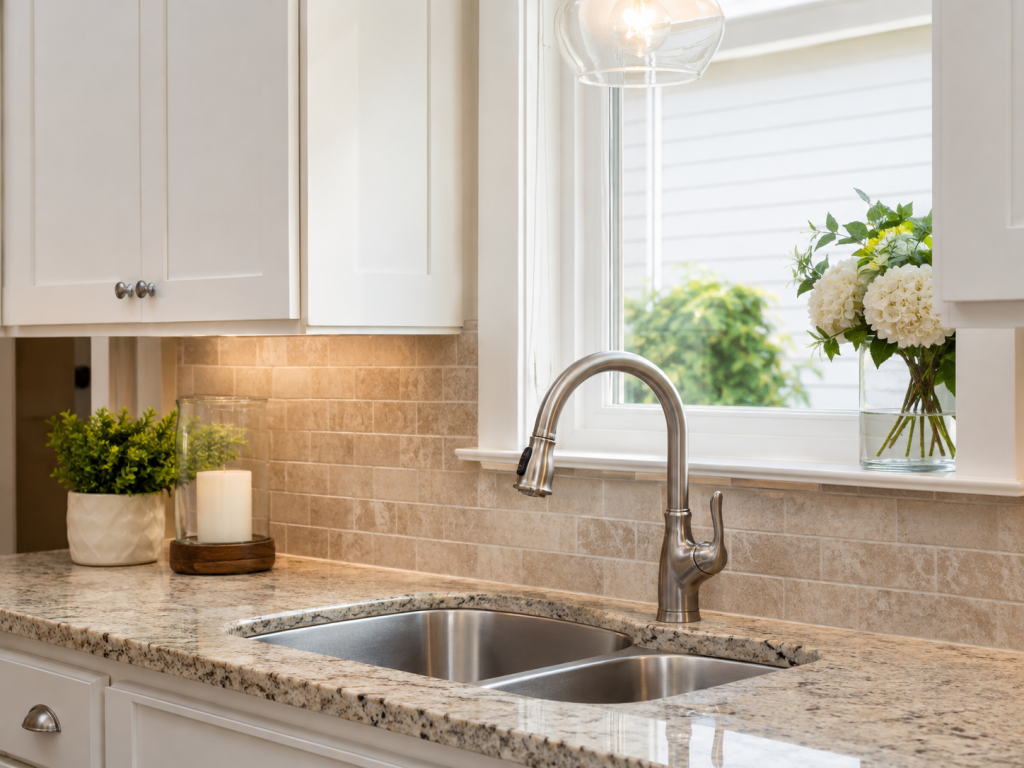
What does worn granite sealer look like?
Worn sealer usually becomes noticeable when water begins darkening the surface faster than it did before.
Common warning signs include:
- dark rings around soap dispensers or faucet bases;
- temporary dark patches after wiping the countertop;
- water soaking in instead of remaining in droplets;
- oil marks near the cooktop;
- darker areas along sink edges;
- stains becoming harder to remove;
- uneven absorption across the same countertop.
Granite sealer does not usually peel like paint or create a visible layer on top. Most stone sealers are penetrating products that work below the surface, so homeowners often notice reduced performance before seeing any obvious physical change.
A darker area beside the sink does not automatically mean the granite is ruined. The first step is allowing the surface to dry completely and checking whether the original color returns.
How can you test whether granite needs resealing?
A simple water test can help determine whether the surface is absorbing moisture too quickly.
Place a small amount of clean water on several parts of the countertop, including a frequently used area and a less-used section. Leave it for approximately 10–15 minutes, then wipe it away.
If the water remains on the surface without creating a dark mark, the existing protection may still be functioning adequately.
If the granite darkens quickly beneath the water, the surface may be ready for resealing. The dark area should gradually return to its original color as the moisture evaporates.
This test is not perfect. Some dense granites naturally require little or no frequent sealing, while more porous stones may respond differently. Product instructions and professional evaluation should take priority over a universal schedule.
For homeowners comparing granite countertop stores in Millersville, TN, it is worth asking how the selected slab behaves before installation instead of assuming every granite requires identical care.
Can moisture permanently damage granite?
Water alone usually causes temporary darkening rather than permanent damage, but repeated moisture exposure can create other problems.
Plain water often evaporates without leaving a lasting mark. The risk increases when the absorbed liquid contains oils, dyes, minerals, soap, makeup, food pigments, or cleaning chemicals.
For example, water around a sink may carry soap and mineral residue. Cooking areas may be exposed to grease. Bathrooms may encounter cosmetics, hair products, toothpaste, and colored liquids.
Persistent moisture can also affect the material around the granite. Failed caulk, damaged sink mounting, cabinet swelling, or water penetration beneath the countertop may become more serious than absorption into the stone itself.
A sealer reduces absorption time and gives homeowners more opportunity to clean spills. It does not make granite completely waterproof.

How often should granite be resealed?
Granite should be resealed when its absorption behavior indicates that protection has weakened—not automatically according to one fixed annual schedule.
Some countertops may need attention more frequently, while dense granite can remain protected for several years. The interval depends on:
- the granite’s natural porosity;
- the quality of the sealer;
- how the product was applied;
- cleaning products used;
- frequency of cooking;
- exposure to water and oil;
- whether the finish is polished, honed, or leathered.
Harsh or acidic cleaners can reduce sealer performance. Abrasive products may also affect the finish over time.
Granite Empire of Nashville recommends using a pH-neutral stone cleaner or mild dish soap with warm water for routine cleaning. Avoid relying on vinegar, lemon-based cleaners, or abrasive powders for natural-stone care.
Are polished and honed granite affected differently?
Yes. Honed granite can show moisture and oil marks more visibly than polished granite, although the exact result depends on the stone.
Polished granite has a glossy, reflective surface that intensifies the color and generally slows absorption compared with the same stone in a less refined finish.
Honed granite has a matte or satin appearance. It can create a softer design, but dark honed stone may show fingerprints, cooking oils, and temporary moisture marks more clearly.
Leathered granite has a textured finish that can hide fingerprints and minor daily marks, although its surface texture requires careful cleaning around small grooves.
| Granite finish | Appearance | Moisture consideration |
|---|---|---|
| Polished | Glossy and reflective | Usually easiest to wipe clean |
| Honed | Matte or satin | May show dark moisture or oil marks |
| Leathered | Textured and low-sheen | Can hide fingerprints but needs careful cleaning |
The finish should be considered during slab selection because it affects both appearance and everyday maintenance.
How does granite compare with quartz around water?
Quartz is non-porous and does not require routine sealing, while granite is natural and may need periodic resealing.
Engineered quartz is generally made from crushed quartz minerals combined with polymer resins and pigments. Brands such as Cambria, Silestone, Caesarstone, MSI Quartz, and Vicostone offer consistent patterns and low-maintenance surfaces.
Granite provides natural mineral variation, excellent heat resistance, and a completely unique slab.
At Granite Empire of Nashville, current starting prices are:
| Material | Starting price | Sealing requirement |
|---|---|---|
| Granite | From $48/sq. ft. | May require periodic sealing |
| Quartz | From $58/sq. ft. | No routine sealing |
| Marble | From $68/sq. ft. | Requires careful sealing and acid protection |
| Quartzite | Price available upon request | Usually requires sealing |
For many kitchens, granite remains a practical choice because its moisture sensitivity is manageable with correct sealing and basic spill cleanup.
Homeowners researching granite countertop stores in Millersville, TN should compare the full process—not only the advertised square-foot price.
What should you do if granite develops a dark spot?
Allow the stone to dry before deciding whether the mark is permanent.
Remove any object covering the area, wipe away surface moisture, and give the granite adequate ventilation. Depending on the amount absorbed, drying can take several hours or longer.
Do not immediately apply more sealer over a wet area. Trapping moisture beneath a new application can make the problem more difficult to evaluate.
If the mark remains after the stone has dried, it may be a stain rather than simple moisture. Oil-based and organic stains require different treatment methods, so identifying what caused the mark is important before using a poultice or cleaning product.
Around sinks, also inspect the faucet, caulk, soap dispenser, and sink mounting for leaks. Repeated water exposure may indicate a plumbing or sealing issue rather than ordinary countertop use.
Frequently Asked Questions
Can granite absorb water if it is not sealed?
Yes. Because granite is a natural stone with microscopic pores, some varieties can absorb water when unsealed or when the existing sealer has weakened. The absorption rate depends on the density and mineral structure of the specific slab.
Does a dark water spot mean granite is permanently stained?
Not always. If the mark gradually disappears as the countertop dries, it was probably temporary moisture absorption. A spot that remains after the granite is completely dry may contain oil, pigment, soap residue, or minerals and may require stain treatment.
How much do granite countertops cost at Granite Empire of Nashville?
Granite starts at approximately $48 per square foot. Final pricing depends on the selected slab, total square footage, edge profile, cutouts, seams, finish, fabrication requirements, delivery, and installation.
How long does a granite countertop project take?
A typical project takes approximately 2–3 weeks. Fabrication normally requires 7–10 business days after templating, followed by around 1–2 days for installation.
Does Granite Empire of Nashville serve Millersville, TN?
Yes. Granite Empire of Nashville serves homeowners looking for granite countertop stores in Millersville, TN. We provide granite selection, professional templating, custom fabrication, edge finishing, delivery, installation, and guidance on sealing and long-term stone care.
Granite Empire of Nashville
4160 Gallatin Pike, Nashville, TN 37216
Phone: (615) 200-1591