
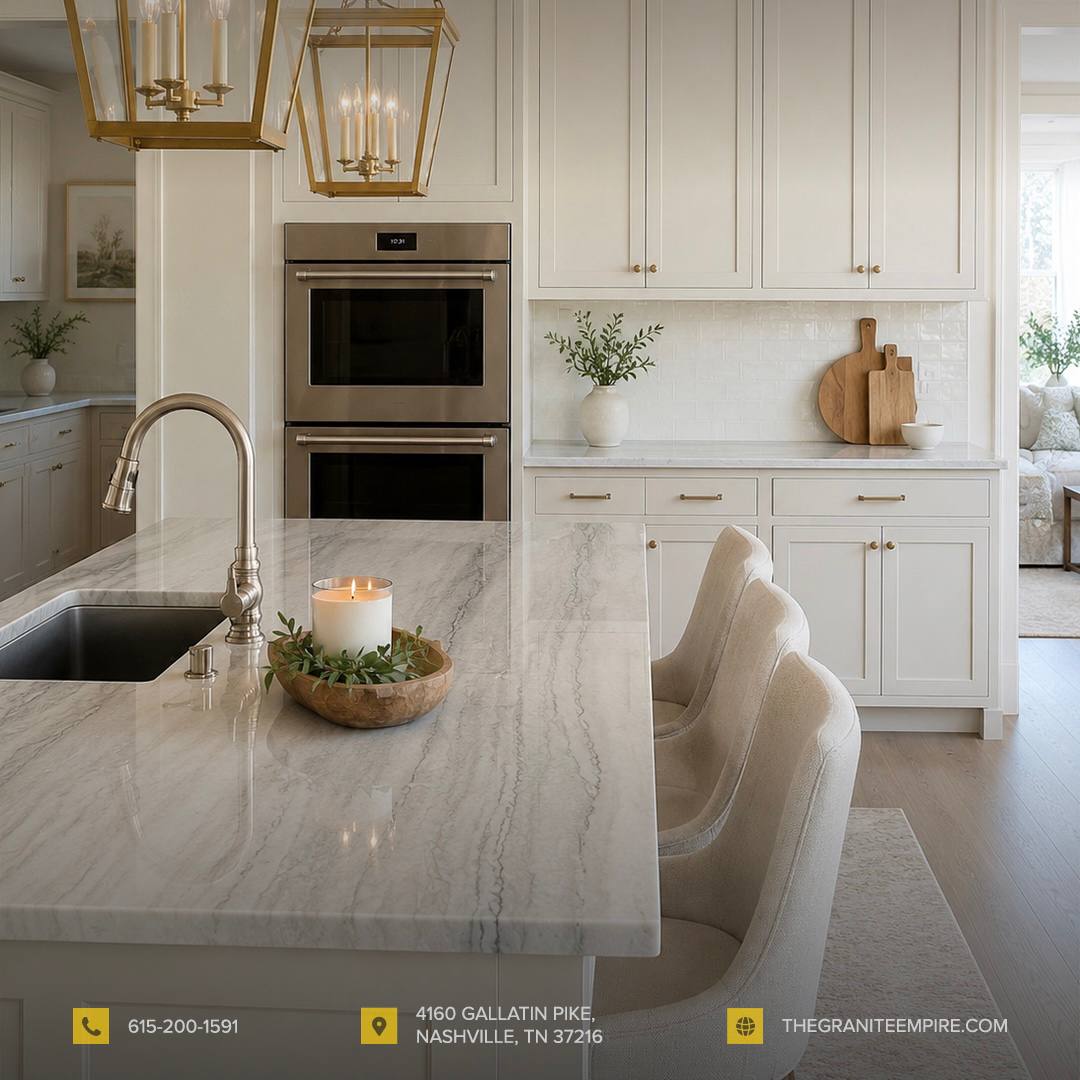
The easiest marble colors to maintain are usually medium-light stones with visible veining and moderate pattern variation. They do not resist stains or etching better simply because of their color, but they tend to hide small water spots, crumbs, faint discoloration, and natural wear more effectively than pure white or very dark marble.
For most active kitchens, softly patterned Carrara-style marble is more forgiving than a nearly solid white slab. Beige and warm-toned marble can also be practical because minor marks blend into the background. Dark marble looks dramatic, but dull etched spots often become more visible against black, charcoal, or deep brown surfaces.
At Granite Empire of Nashville, we help homeowners choosing marble kitchen countertops in Millersville, TN compare actual slabs, finishes, porosity, veining, and maintenance expectations before fabrication. Color matters, but the stone’s density, finish, sealing, and daily care matter just as much.
Which marble colors hide everyday wear best?
Medium-light marble with visible gray, beige, or gold movement usually hides everyday wear best.
A countertop with moderate veining gives the eye multiple tones and patterns to follow. Small crumbs, faint water marks, and minor variations are less noticeable than they would be on a solid-looking surface.
Good color families to consider include:
- soft white with medium gray veining;
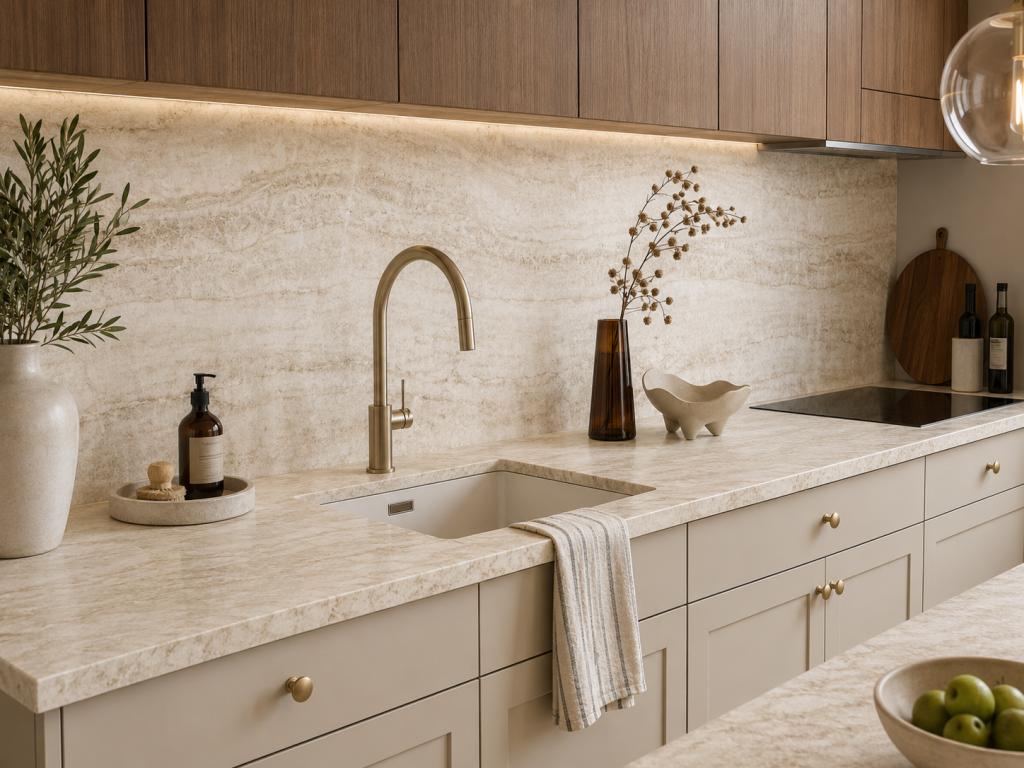
- warm ivory with beige movement;
- cream marble with gold or taupe variation;
- light gray marble with layered patterning;
- medium brown or beige marble with natural movement.
This does not make the stone stain-proof. It simply means normal visual changes are less obvious.
For a busy family kitchen, a highly varied slab may feel easier to live with than a uniform white marble chosen mainly for its clean appearance.
Is Carrara marble easier to maintain than Calacatta marble?
Carrara often feels easier to maintain visually because its softer gray background and more frequent veining can disguise minor wear.
Carrara marble typically has a white-to-light-gray base with fine or cloudy gray movement. The pattern is often distributed across the slab rather than concentrated into a few dramatic veins.
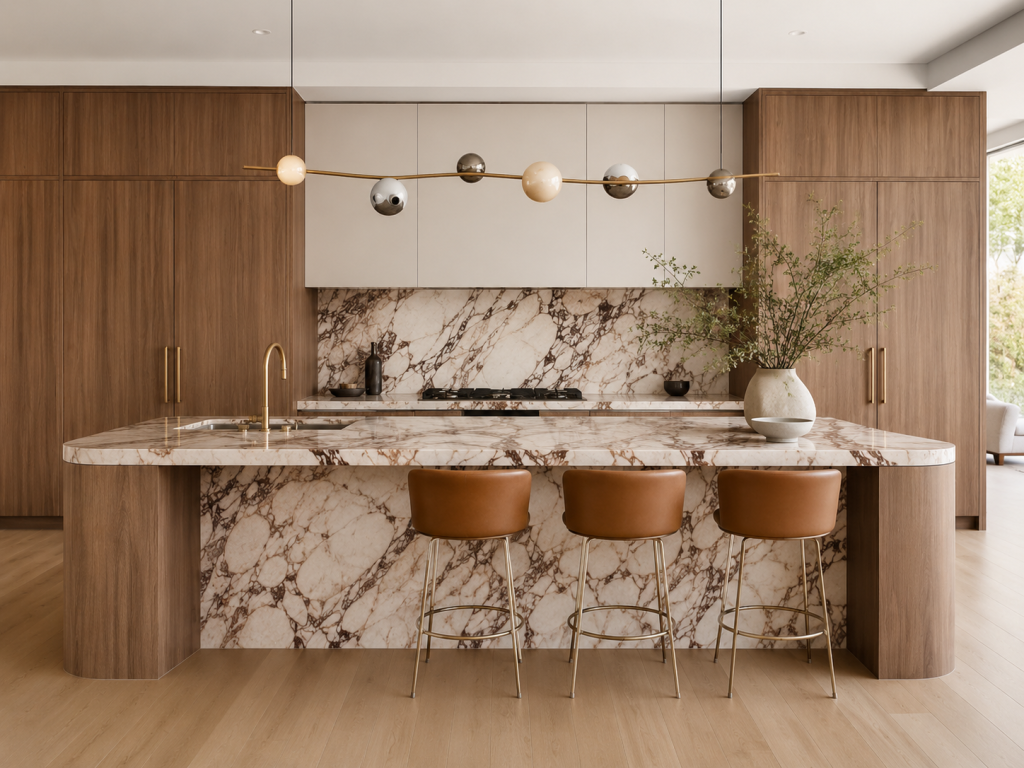
Calacatta marble usually has a brighter white background with larger, more defined gray, beige, or gold veining. Its clean areas can make stains, oil marks, or discoloration easier to notice.
Calacatta is not necessarily more porous simply because it is Calacatta. Individual slabs can behave differently. However, homeowners often expect its bright white areas to remain visually perfect, making normal aging feel more noticeable.
Other well-known marble styles include Statuario, which commonly has a bright white background and dramatic gray movement; Crema Marfil, known for warm beige coloring; Emperador, with rich brown tones; and Nero Marquina, a dark stone with contrasting white veining.
Does dark marble require less maintenance?
No. Dark marble does not require less maintenance, and it may show etching more clearly than lighter stone.
Acidic liquids react with the calcite in marble, creating dull marks called etches. On black or dark brown marble, the loss of shine can create an obvious pale or cloudy spot.
Examples include Nero Marquina and darker Emperador selections. These stones can hide some food stains and crumbs well, but they may reveal:
- hard-water residue;
- fingerprints;
- soap film;
- light scratches;
- dull etched areas;
- dust along the surface.
Dark marble can still be an excellent design choice, especially for islands, wet bars, vanities, and lower-use areas. It should simply be selected for its appearance rather than under the assumption that dark color makes it easier to maintain.
Does white marble stain more easily than beige marble?
Not necessarily, but stains are often easier to see on bright white marble.
The absorption rate depends on the specific slab and how well it is sealed, not only its color. A dense white marble may absorb less than a more porous beige stone.
However, visual contrast matters. Coffee, oil, wine, rust, and food pigments stand out clearly against a bright white background. On beige, cream, or heavily veined marble, subtle discoloration may blend into the stone more naturally.
The most practical approach is to inspect the actual slab and ask about sealing rather than choosing solely by color name.
At Granite Empire of Nashville, marble starts at approximately $68 per square foot. Final pricing depends on the marble selection, slab requirements, dimensions, edge profile, cutouts, finish, custom fabrication, and installation.
Does a honed finish make marble easier to live with?
A honed finish often makes marble easier to live with because etching blends into the low-sheen surface more naturally.
Polished marble reflects light and creates deeper color and stronger contrast. When acidic liquids etch the surface, they remove part of that shine. The dull area therefore stands out against the polished background.
Honed marble already has a matte or satin appearance. Acid can still etch it, but the visual difference may be less dramatic.
The tradeoff is that honed marble can absorb liquids more readily in some situations and may show oil marks, especially on darker colors. Proper sealing remains important.
| Marble choice | What it tends to hide | What may remain visible | Practical fit |
|---|---|---|---|
| Soft gray Carrara-style | Minor wear and light marks | Acid etching, dark spills | Active kitchens |
| Bright Calacatta-style | Pattern can hide some marks | Stains on open white areas | Statement kitchens |
| Warm beige or cream | Crumbs and faint discoloration | Oil and acidic spills | Traditional, warm interiors |
| Dark brown or black | Some food stains | Etching, dust, fingerprints | Lower-use or dramatic spaces |
| Honed medium-light marble | Dull wear and minor etching | Oil marks if not cleaned quickly | Homeowners accepting patina |
Which marble color is best for a heavily used kitchen?
Soft gray, warm white, or beige marble with moderate movement is usually the most forgiving choice for a heavily used kitchen.
A very uniform white slab can look exceptional on installation day, but it gives every spill and change a clean background against which to appear. A highly patterned marble integrates those changes more naturally.
For homeowners considering marble kitchen countertops in Millersville, TN, we often recommend comparing slabs from normal standing distance rather than examining only a small sample.
A sample cannot show:
- how frequently the veining repeats;
- where large white areas appear;
- whether one side is darker;
- how the pattern will cross an island;
- where seams and cutouts may fall.
The full-slab layout is especially important with Calacatta, Statuario, and other marbles featuring broad directional veins.
How should marble be cleaned and protected?
Marble should be cleaned with a pH-neutral stone cleaner or mild dish soap, warm water, and a soft cloth.
Avoid vinegar, lemon-based cleaners, abrasive powders, bleach-heavy products, and acidic bathroom or kitchen sprays. Even when these products do not leave a permanent stain, they can dull the finish.
Daily habits matter more than marble color:
- wipe acidic spills promptly;
- use cutting boards during food preparation;
- place coasters under citrus drinks and wine;
- use trivets under hot cookware;
- avoid leaving cooking oils on the surface;
- reseal when the stone begins absorbing moisture.
Sealer helps reduce staining by slowing absorption. It does not prevent etching because the acid reaction occurs at the marble surface itself.
How does marble compare with other countertop materials?
Marble offers unmatched natural depth and veining, but granite and quartz are generally easier choices for homeowners who want fewer visible changes.
At Granite Empire of Nashville, current starting prices are:
| Material | Starting price | Everyday maintenance |
|---|---|---|
| Granite | From $48/sq. ft. | Periodic sealing; strong heat resistance |
| Quartz | From $58/sq. ft. | Non-porous; protect from high heat |
| Marble | From $68/sq. ft. | Seal and protect from acidic spills |
| Quartzite | Price available upon request | Periodic sealing; strong heat resistance |
Granite is often the practical alternative when natural stone and heat resistance are priorities. Quartz provides consistent patterns from brands such as Cambria, Silestone, Caesarstone, MSI Quartz, and Vicostone, with no routine sealing requirement.
Marble is the right choice when the homeowner values authentic veining and accepts that a working kitchen surface may develop patina.
Frequently Asked Questions
What is the easiest marble color to maintain in a kitchen?
Soft gray, warm white, beige, and moderately veined marble are usually the most forgiving. They do not prevent etching or staining, but they can make small marks and normal wear less visually obvious.
Is Carrara or Calacatta marble better for everyday use?
Carrara is often easier to live with visually because its gray background and distributed veining can hide minor wear. Calacatta provides a brighter, more dramatic appearance, but marks may stand out more clearly across its large white areas.
How much does marble cost at Granite Empire of Nashville?
Marble starts at approximately $68 per square foot. Final pricing depends on the selected slab, dimensions, finish, edge profile, cutouts, fabrication complexity, delivery, and installation.
How long does a marble countertop project take?
A typical project takes approximately 2–3 weeks. Fabrication usually requires 7–10 business days after templating, followed by around 1–2 days for installation.
Does Granite Empire of Nashville serve Millersville, TN?
Yes. Granite Empire of Nashville serves homeowners looking for marble kitchen countertops in Millersville, TN, providing marble selection, professional templating, custom fabrication, delivery, and installation. Customers can visit our Nashville showroom to compare marble slabs and discuss maintenance, finish, and project pricing.
Granite Empire of Nashville
4160 Gallatin Pike, Nashville, TN 37216
Phone: (615) 200-1591