
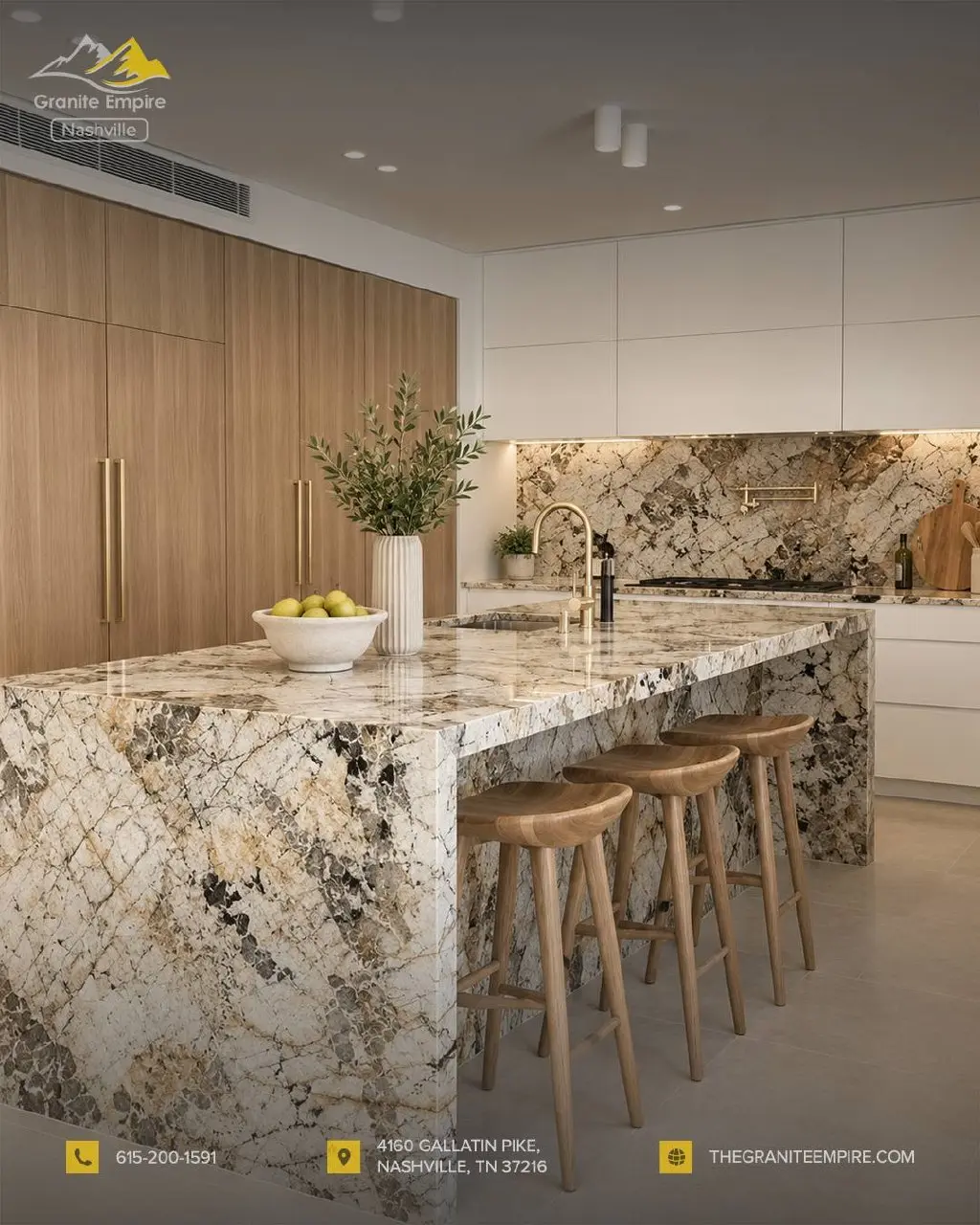
For a large kitchen island, you need a granite slab that is larger than the island’s finished countertop dimensions—not simply a slab with the same measurements. A typical granite slab is roughly 9–10 feet long and 5–6 feet wide, although dimensions vary significantly by quarry, stone, and individual slab. If an island approaches the usable dimensions of the slab, seams, edge fabrication, sink or cooktop cutouts, and pattern placement become important.
An 8-foot by 4-foot island will often fit within one appropriately sized slab. A 10-foot island, an unusually deep island, or a waterfall design may require a larger slab or multiple pieces.
At Granite Empire of Nashville, we help homeowners planning granite kitchen countertops in Millersville, TN inspect actual slabs before fabrication. For oversized islands, knowing the exact slab dimensions is just as important as choosing the color.
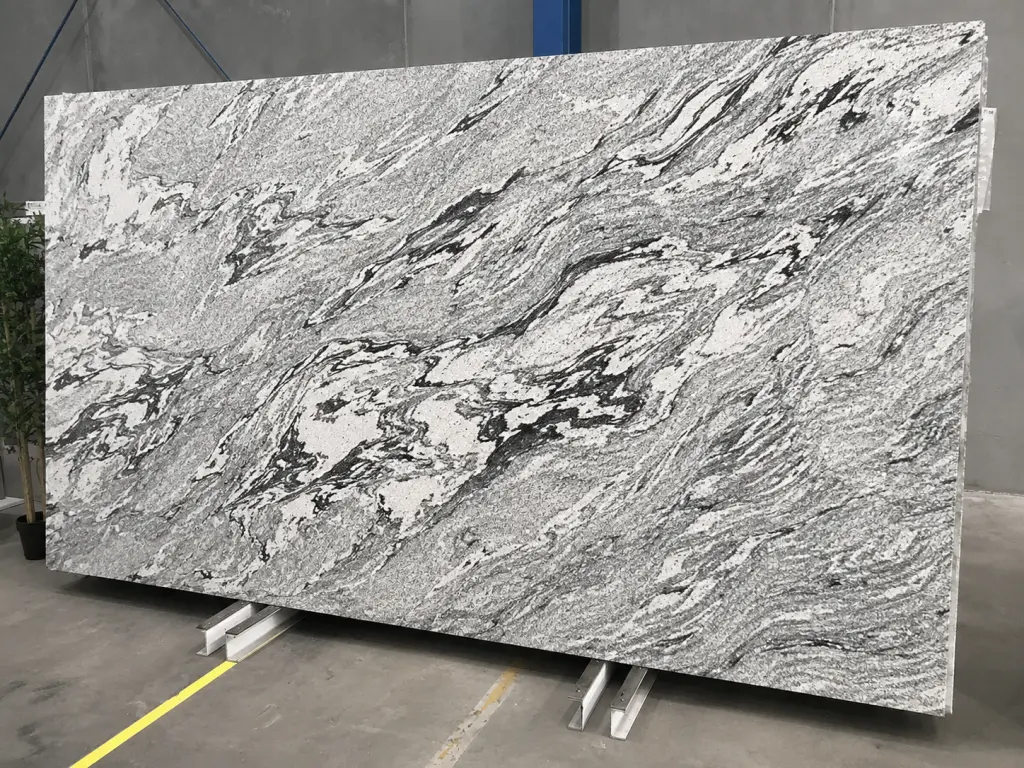
How large is a standard granite slab?
Most granite slabs are approximately 9–10 feet long and 5–6 feet wide, but there is no universal standard size.
Granite is quarried as a natural material rather than manufactured to one fixed sheet dimension. One bundle may contain slabs measuring close to 120 inches long, while another granite may arrive noticeably smaller.
Thickness matters as well. In American kitchens, 3 cm granite—about 1¼ inches thick—is a common countertop choice because it creates a substantial edge and generally requires less added buildup than thinner stone.
The usable area is also smaller than the slab’s published dimensions. Fabricators need to account for:
- natural imperfections;
- damaged or irregular slab edges;
- veining and mineral movement;
- countertop overhangs;
- sink or cooktop openings;
- seam placement;
- finished edges.
This is why we never recommend designing an island around an assumed “standard slab” before checking the actual stone.
Can an 8-foot kitchen island fit on one granite slab?
Yes, an 8-foot island will often fit on one full granite slab, especially when the island is around 36–48 inches deep.
For example, an island countertop measuring 96 × 48 inches requires 32 square feet of finished surface. A granite slab measuring around 120 × 70 inches provides substantially more raw material, although not every inch will necessarily be usable.
The calculation becomes tighter when the island includes a large overhang.
An island cabinet may be only 36 inches deep, but adding 12–15 inches of seating overhang can increase the finished countertop depth to approximately 48–51 inches.
That still may fit comfortably on many slabs, but the actual dimensions should be verified before fabrication.
For granite kitchen countertops in Millersville, TN, we template the finished cabinet layout rather than relying only on the cabinet manufacturer’s nominal measurements.
How big can a granite island be without a seam?
A granite island can remain seamless only when the entire finished countertop fits safely within the usable portion of one slab.
This means the maximum seamless size is determined by the individual slab, not a universal island measurement.
An island around 8 feet long is often straightforward. Once islands reach approximately 9–10 feet, slab availability becomes much more important. Very deep islands can create the same issue even when they are not especially long.
A seam may also become necessary even when the raw square footage technically fits.
Consider a granite slab with dramatic diagonal movement. Rotating the island template simply to make it fit might place the pattern in an unattractive direction. In that case, using two strategically positioned pieces may produce a better result than forcing a one-piece layout.
Access matters too. A huge granite island top can weigh several hundred pounds. Doorways, hallways, stairs, cabinet support, and the number of installers required can affect whether transporting one enormous piece is practical or safe.
Does a sink or cooktop change the slab size you need?
Yes. Large cutouts can affect both slab layout and structural planning.
An undermount sink removes a substantial section from the middle of the stone. A cooktop can create an even larger opening with relatively narrow strips of granite remaining around it.
Those narrow areas are more vulnerable while the countertop is being fabricated and transported.
We therefore consider not only whether the island shape fits on the slab, but also:
- where the sink sits;
- where the cooktop sits;
- how much stone remains around each opening;
- whether faucets or accessories require additional holes;
- where natural fissures appear;
- how the piece can be safely carried into the home.
Granite typically ranks around 6–7 on the Mohs hardness scale, making it highly resistant to everyday scratching. But hardness does not mean an oversized piece with large cutouts cannot crack during handling if it is poorly planned.
Which granite patterns work best on a large island?
Large islands give dramatic granite patterns enough space to be seen properly.
A small countertop run may show only a fragment of a stone’s movement. A 7-, 8-, or 9-foot island can display the slab almost like a horizontal piece of natural artwork.
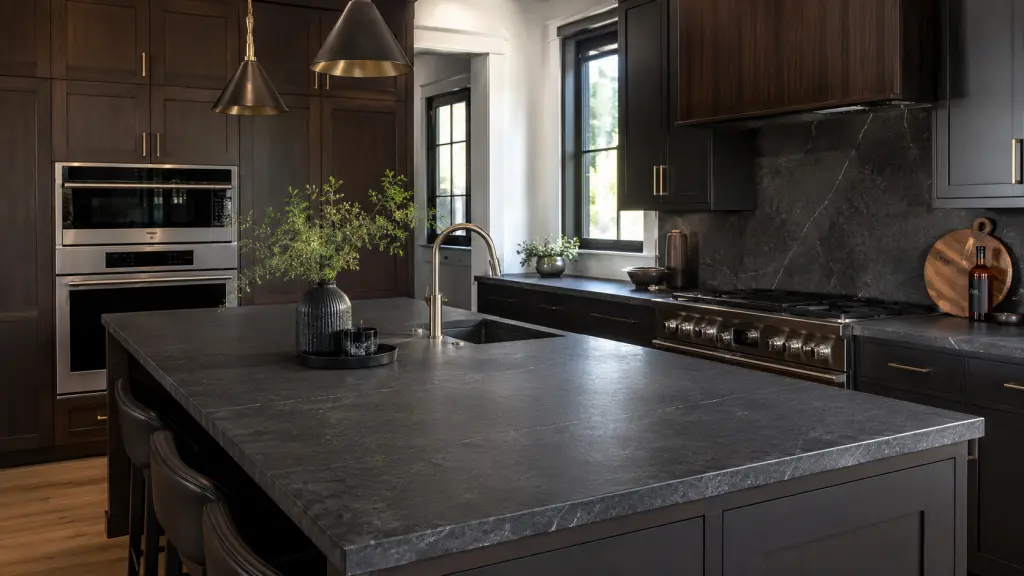
Granites such as Dallas White, Luna Pearl, New Caledonia, Santa Cecilia, River White, White Ice, and Black Pearlcreate very different effects.
Luna Pearl and New Caledonia have relatively distributed mineral patterns, making layout more forgiving.
River White and White Ice may have more noticeable directional movement, so the exact position of the island template becomes more important.
For highly dramatic or exotic granite, we pay particular attention to areas that would disappear into sink or cooktop cutouts. Nobody wants one of the most interesting sections of a slab removed simply because the layout was not considered before cutting.
What happens if the island requires two granite slabs?
If one slab is not large enough, the countertop can be fabricated in multiple sections with a carefully planned seam.
A seam is not automatically a sign of poor fabrication. On oversized stone installations, it can be structurally necessary and visually appropriate.
The goal is to place it somewhere that:
- has adequate cabinet support underneath;
- does not create an unnecessarily weak section;
- allows attractive pattern alignment;
- avoids awkward intersections with major cutouts;
- remains as visually unobtrusive as possible.
With consistent granite, seam matching can be relatively straightforward. With strongly directional stone, two pieces may require more deliberate positioning.
If the slabs are from the same bundle, their coloring and mineral structure are usually more compatible than two unrelated slabs, although natural stone will never provide perfectly identical repetition.
Does a waterfall island require more granite?
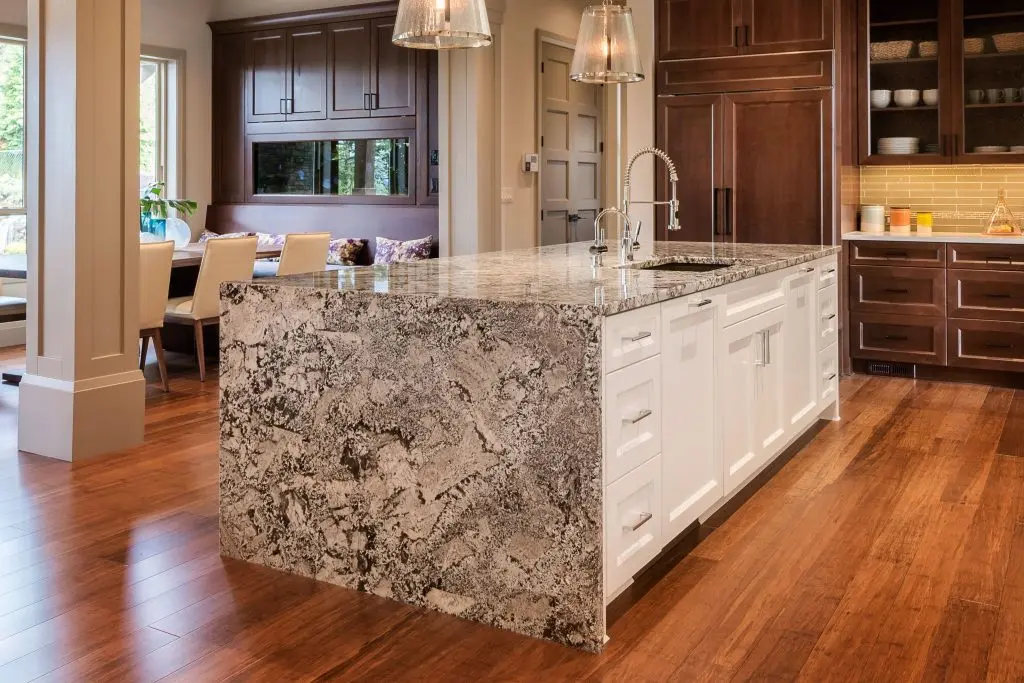
Yes. A waterfall island requires substantially more stone because granite continues vertically down one or both sides of the cabinetry.
Suppose a finished island is approximately 36 inches high and 48 inches deep. One waterfall panel adds roughly 12 square feet of granite. Two sides add approximately 24 additional square feet, before accounting for fabrication and waste.
That additional material may push a project from one slab into two slabs.
Pattern alignment also becomes more important. Ideally, the movement across the horizontal surface appears to continue naturally down the vertical panel.
For homeowners planning granite kitchen countertops in Millersville, TN, deciding on waterfall sides before selecting the slab is much better than adding them after the material has already been allocated.
How much does granite for a large island cost?
At Granite Empire of Nashville, granite starts at approximately $48 per square foot, with the final cost depending on the stone, actual dimensions, number of slabs, edge details, cutouts, fabrication, and installation requirements.
For comparison, our known starting prices are:
| Material | Starting price | Large-island consideration |
|---|---|---|
| Granite | From $48/sq. ft. | Natural slab dimensions and pattern matter |
| Quartz | From $58/sq. ft. | Consistent engineered patterns |
| Marble | From $68/sq. ft. | Natural movement; softer material |
| Quartzite | Price available upon request | Premium natural-stone selection |
A simple 8 × 4-foot island has approximately 32 square feet of countertop surface. At a granite starting price of $48 per square foot, the stone value begins around $1,536 before project-specific fabrication, cutouts, edge choices, additional slab requirements, and installation details are considered.
An oversized island may cost disproportionately more if increasing its dimensions means purchasing another full slab.
Should a large island use granite or quartz?
Granite is especially attractive for a large island when you want a unique natural pattern and excellent heat resistance.
Quartz has advantages when predictable patterning and minimal maintenance are priorities. Manufacturers such as Cambria, Silestone, Caesarstone, MSI Quartz, and Vicostone produce large-format designs with both subtle and dramatic veining.
Granite, however, gives every island a genuinely individual appearance. No two slabs have exactly the same mineral pattern.
It also handles high heat significantly better than engineered quartz because granite contains no heat-sensitive polymer resin.
For an island used for cooking, serving, baking, and entertaining, that combination can make granite particularly practical.
How long does a large granite island take to fabricate and install?
Most Granite Empire of Nashville countertop projects take approximately 2–3 weeks, with fabrication requiring around 7–10 business days after templating and installation generally taking 1–2 days.
Large islands may require extra planning because slab layout, seam positioning, cutouts, transport, and structural support need to be confirmed before fabrication.
Our process includes material selection, professional templating, slab layout, custom fabrication, sink and cooktop cutouts, edge finishing, delivery, and installation.
Cabinets should be installed, level, and securely anchored before the final template. For substantial seating overhangs, support requirements should also be resolved before the granite arrives.
Granite Empire of Nashville
4160 Gallatin Pike, Nashville, TN 37216
Phone: (615) 200-1591