
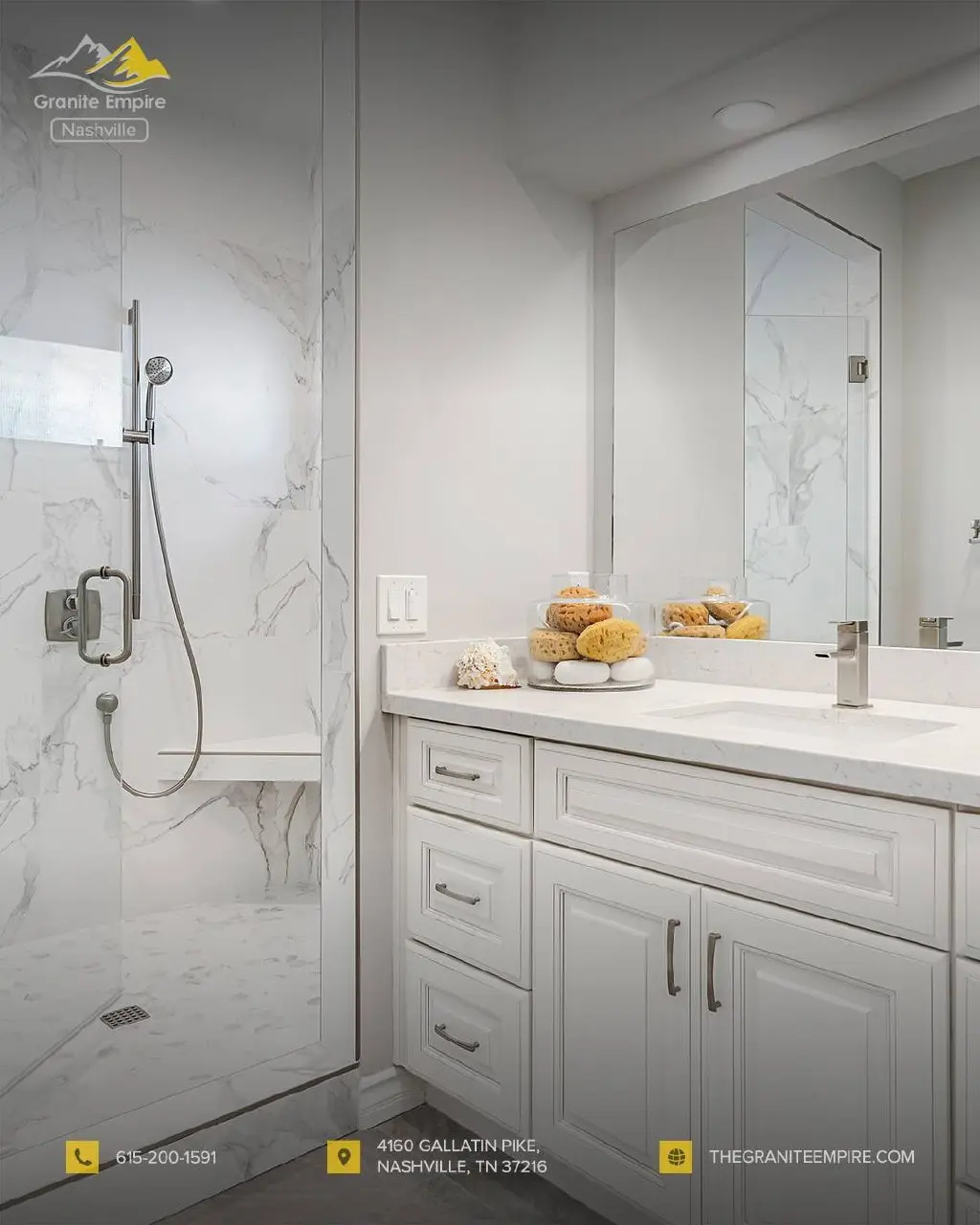
Whether a bathroom countertop needs sealing depends primarily on the material. Granite and other porous natural stones may benefit from sealing, while quartz is non-porous and does not require routine sealing. Marble can also benefit from sealing, although sealing does not make it resistant to etching.
For a bathroom vanity, sealing is mainly about reducing absorption and giving you additional protection against moisture, cosmetics, soap, and everyday spills. It is not a replacement for regular cleaning or proper care.
At Granite Empire of Nashville, we help homeowners choosing bathroom countertops in Pleasant View, TN understand the maintenance requirements before selecting a material. The right countertop is not simply the one that looks best – it should also fit how much maintenance you are comfortable with.
Which bathroom countertop materials need sealing?
Natural stone and engineered stone behave differently.
Granite is a natural stone and some varieties are more porous than others. Depending on the specific slab, sealing can help reduce liquid absorption.
Marble is also a natural stone and can benefit from sealing, particularly in a bathroom where the surface regularly encounters water and personal-care products.
Quartz is engineered and non-porous, so routine sealing is not required.
Quartzite is a natural stone, so its maintenance requirements depend on the particular slab and its porosity.
For homeowners comparing bathroom countertops in Pleasant View, TN, the most important step is to identify the exact material before assuming that every stone requires the same maintenance schedule.
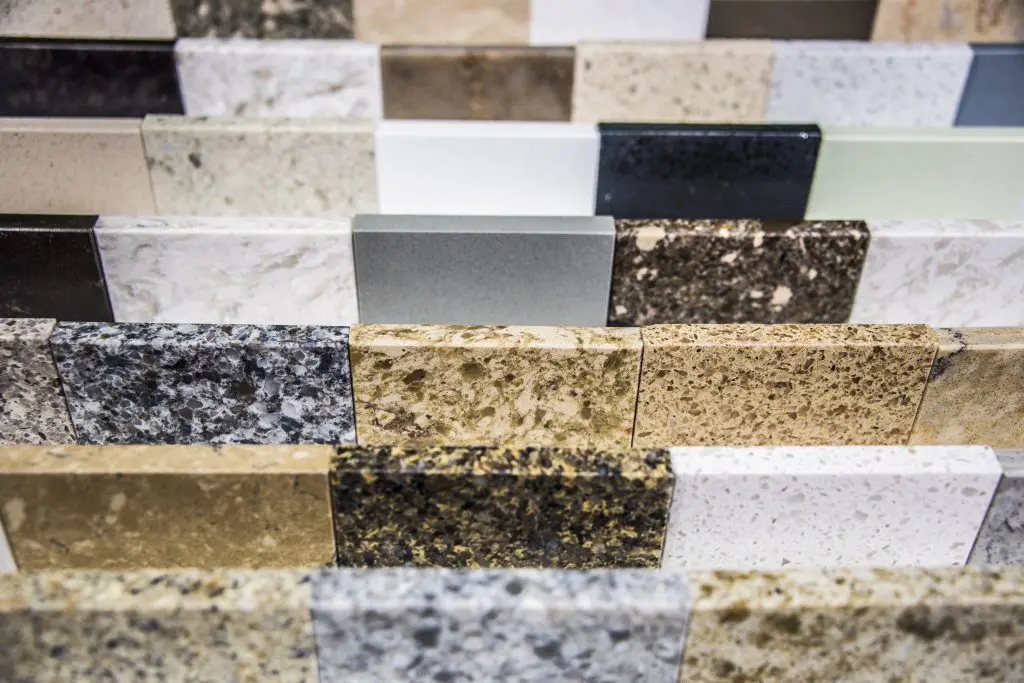
Does granite need to be sealed in a bathroom?
Many granite countertops benefit from sealing, but not every granite requires the same frequency.
Granite varies naturally in density and porosity. A dense granite may absorb very little moisture, while another variety may be more absorbent.
A bathroom environment makes this worth considering because the vanity is exposed to:
- water;
- toothpaste;
- cosmetics;
- soap;
- lotions;
- cleaning products.
A properly sealed granite surface gives liquids less opportunity to penetrate the stone.
At Granite Empire of Nashville, granite starts at approximately $48 per square foot.
Popular granite options include Black Pearl, Steel Gray, White Ice, River White, Dallas White, and Santa Cecilia. The specific stone should be evaluated rather than assuming that its color determines its sealing requirements.
Does marble need to be sealed?
Marble can benefit from sealing, but sealing does not prevent every type of marble damage.
The main concern with marble in a bathroom is not simply water absorption. Marble can also etch when exposed to acidic substances.
Bathroom products can sometimes contain ingredients that affect natural marble, including certain:
- cleansers;
- cosmetics;
- skincare products;
- hair products.
Sealing can help reduce absorption and staining, but it does not make marble completely stain-proof or etch-proof.
This is why homeowners considering bathroom countertops in Pleasant View, TN should think about both the appearance and maintenance requirements of marble before choosing it for a vanity.
Marble starts at approximately $68 per square foot at Granite Empire of Nashville.
Does quartz need to be sealed?
No. Quartz does not require routine sealing because it is a non-porous engineered material.
This is one of its biggest practical advantages in a bathroom.
Quartz is available in many colors and patterns, including designs that resemble natural marble.
Major quartz manufacturers include:
- Cambria;
- Silestone;
- Caesarstone;
- MSI Quartz;
- Vicostone.
Quartz still needs normal care. Water, soap, makeup, and other products should be cleaned from the surface rather than being allowed to accumulate.
Quartz also has a heat limitation because it contains resin binders, although this is generally less relevant in a bathroom than in a kitchen.
Quartz starts at approximately $58 per square foot.
Does quartzite need to be sealed?
Quartzite is natural stone, so sealing requirements depend on the specific material.
Despite the similar name, quartzite should not be treated exactly like engineered quartz.
Some quartzite slabs are relatively dense, while others can be more absorbent.
This is why the specific slab matters when determining maintenance.
Quartzite can be an excellent choice for homeowners who want:
- natural stone variation;
- dramatic veining;
- strong durability;
- a marble-like appearance.
Pricing at Granite Empire of Nashville is available upon request, since the selected quartzite slab has a significant effect on the price.
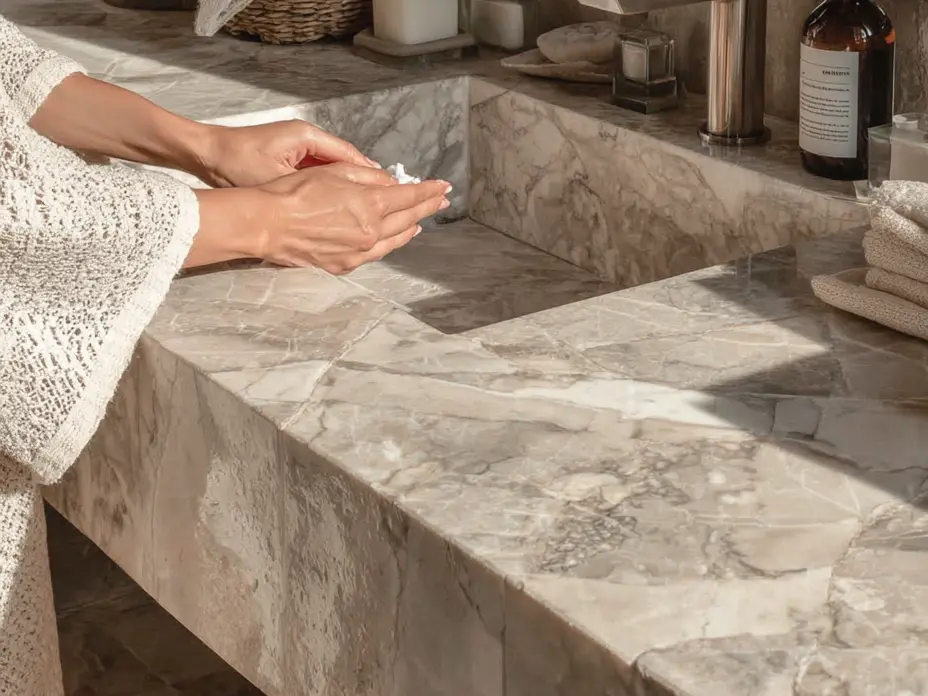
How often should a bathroom countertop be sealed?
There is no universal sealing schedule that applies to every natural stone countertop.
The frequency depends on:
- material;
- stone porosity;
- countertop usage;
- exposure to moisture;
- type of sealer;
- previous sealing.
Instead of automatically resealing every year, homeowners should pay attention to how the stone responds to moisture.
If water begins absorbing into the surface more readily than before, it may be time to evaluate the seal.
A professional can also test the surface and determine whether additional sealing is necessary.
How can you tell if a granite countertop needs sealing?
One simple indicator is how the surface responds to water.
If a small amount of water is placed on an appropriate area of the stone and the surface darkens relatively quickly as the moisture absorbs, the countertop may need additional protection.
If moisture remains on the surface rather than immediately absorbing, the existing protection may still be functioning.
This is not a substitute for professional evaluation, especially with valuable natural stone.
Different granite varieties behave differently, so the test should not be interpreted as a universal timetable.
Does sealing prevent bathroom countertop stains?
Sealing can reduce the likelihood of liquids penetrating porous natural stone, but it does not make the surface completely stain-proof.
The best protection combines:
- appropriate sealing;
- prompt cleanup;
- correct cleaning products;
- regular maintenance.
This is particularly important around a bathroom sink, where water and personal-care products are frequently present.
Quartz has an advantage here because its non-porous surface does not require sealing.
For homeowners comparing bathroom countertops in Pleasant View, TN, this difference can be important if low maintenance is a priority.
Can you seal quartz countertops?
Quartz does not need a traditional stone sealer.
Applying a penetrating sealer to a non-porous quartz surface is unnecessary and may leave unwanted residue depending on the product.
Instead, quartz should be maintained through regular cleaning with appropriate products.
This is one reason quartz is popular for bathroom vanities where homeowners want a straightforward maintenance routine.
The lack of sealing does not mean quartz is indestructible. It should still be protected from harsh chemicals, abrasive cleaners, and other inappropriate products.
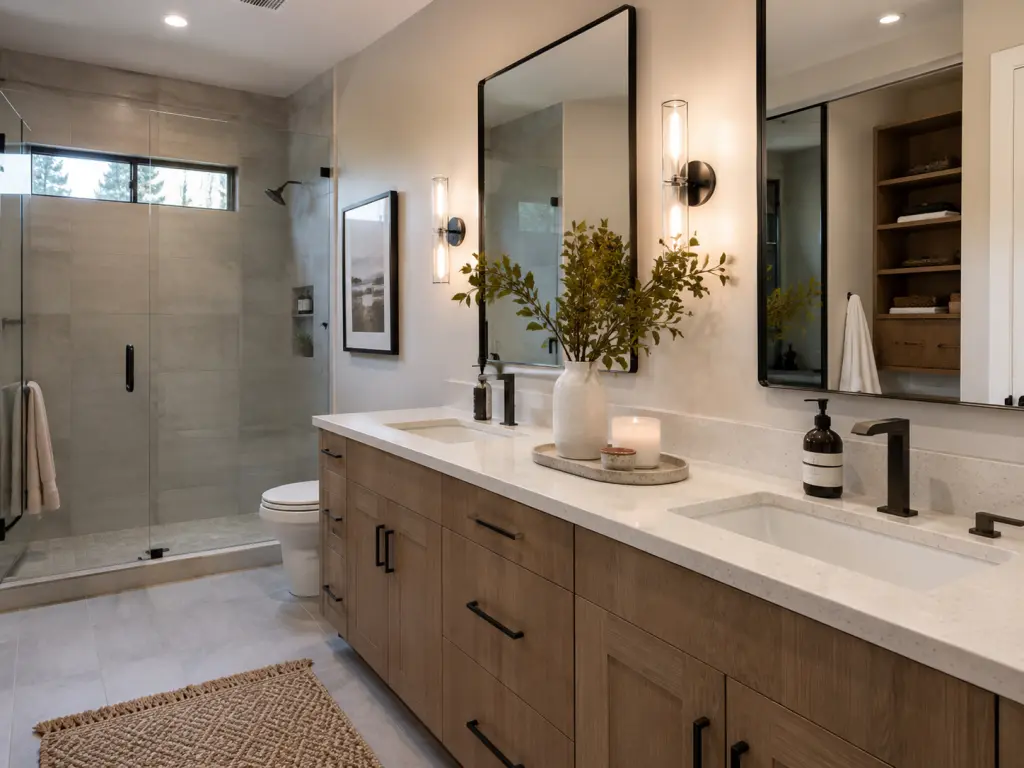
Which bathroom countertop is easiest to maintain?
For homeowners who want the simplest maintenance routine, quartz is often the most straightforward option.
A basic comparison looks like this:
| Material | Sealing | Maintenance |
|---|---|---|
| Quartz | Not required | Low |
| Granite | May be required | Low to moderate |
| Marble | Recommended depending on stone/use | Moderate |
| Quartzite | Depends on slab | Low to moderate |
The exact maintenance requirements can vary within each category.
For example, one granite slab may require less attention than another. Similarly, some quartzite is denser than other varieties.
The material should therefore be evaluated individually.
How much do bathroom countertops cost?
Current starting prices at Granite Empire of Nashville are:
| Material | Starting price |
|---|---|
| Granite | From $48/sq. ft. |
| Quartz | From $58/sq. ft. |
| Marble | From $68/sq. ft. |
| Quartzite | Price available upon request |
For a 20-square-foot bathroom vanity, starting material costs would be approximately:
- Granite: $960
- Quartz: $1,160
- Marble: $1,360
These are material-only examples. The final price can also include:
- sink cutout;
- faucet holes;
- edge profile;
- backsplash;
- fabrication;
- delivery;
- installation.
A specific slab or premium collection may have a different price.
Is sealing worth it for a bathroom vanity?
For porous natural stone, sealing can be a worthwhile part of maintaining the countertop.
The cost and effort of maintaining a natural stone vanity should be considered when choosing the material.
If you love the natural variation of granite or marble, periodic maintenance may be a reasonable tradeoff.
If you want to avoid sealing altogether, quartz offers a practical alternative.
At Granite Empire of Nashville, we help homeowners compare these differences before fabrication so the material matches the way the bathroom will actually be used.
How long does bathroom countertop installation take?
Most countertop projects take approximately 2-3 weeks overall.
After final templating, fabrication generally takes 7-10 business days. During fabrication, we prepare the slab, complete sink and faucet cutouts, finish the selected edge, and prepare the countertop for installation.
Installation typically takes 1-2 days for a standard bathroom vanity.
For homeowners looking for bathroom countertops in Pleasant View, TN, planning the material, edge, sink, faucet holes, and backsplash together helps avoid unnecessary changes later.