
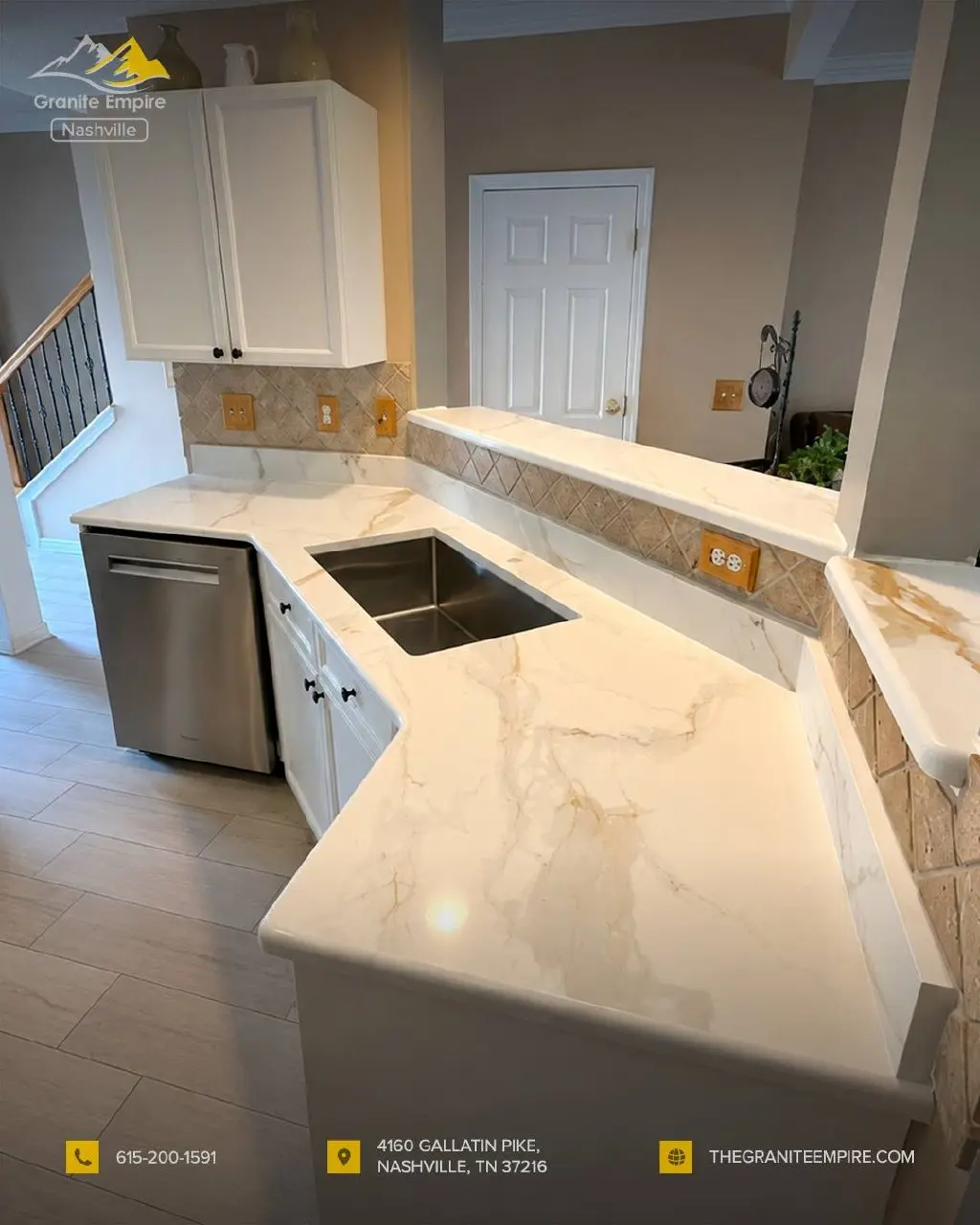
Quartz countertops are designed to resist everyday scratching, so normal kitchen use usually does not leave obvious damage. Still, quartz is not completely scratch-proof. Hard debris trapped beneath an appliance, abrasive cleaning tools, rough-bottom cookware, repeated scraping, and dragging heavy objects across the surface can eventually leave marks or change the finish.
Engineered quartz combines hard mineral quartz with polymer binders and pigments. That construction creates a dense, durable surface that works well in busy kitchens, but it should still be treated as a finished countertop rather than an indestructible work surface.
At Granite Empire of Nashville, we help homeowners choosing quartz kitchen countertops in Forest Hills, TN understand what quartz can realistically handle before templating, fabrication, and installation. In most cases, preventing scratches comes down to a few simple habits rather than intensive maintenance.
How scratch-resistant is quartz in everyday use?
Quartz is highly scratch-resistant and generally handles normal household activity very well.
Plates, glasses, food containers, small appliances, and routine meal prep usually do not damage the surface. The mineral content in engineered quartz is naturally hard, which is one reason the material is so popular in kitchens.
The important distinction is between scratch-resistant and scratch-proof.
A countertop can perform extremely well for years and still be marked by enough pressure, friction, or abrasive debris. The risk increases when a hard particle becomes trapped under something heavy and that object is dragged across the countertop.
For homeowners looking at quartz kitchen countertops in Forest Hills, TN, the realistic expectation is that quartz handles everyday use very well, but basic surface protection is still worthwhile.
Can you cut directly on quartz?
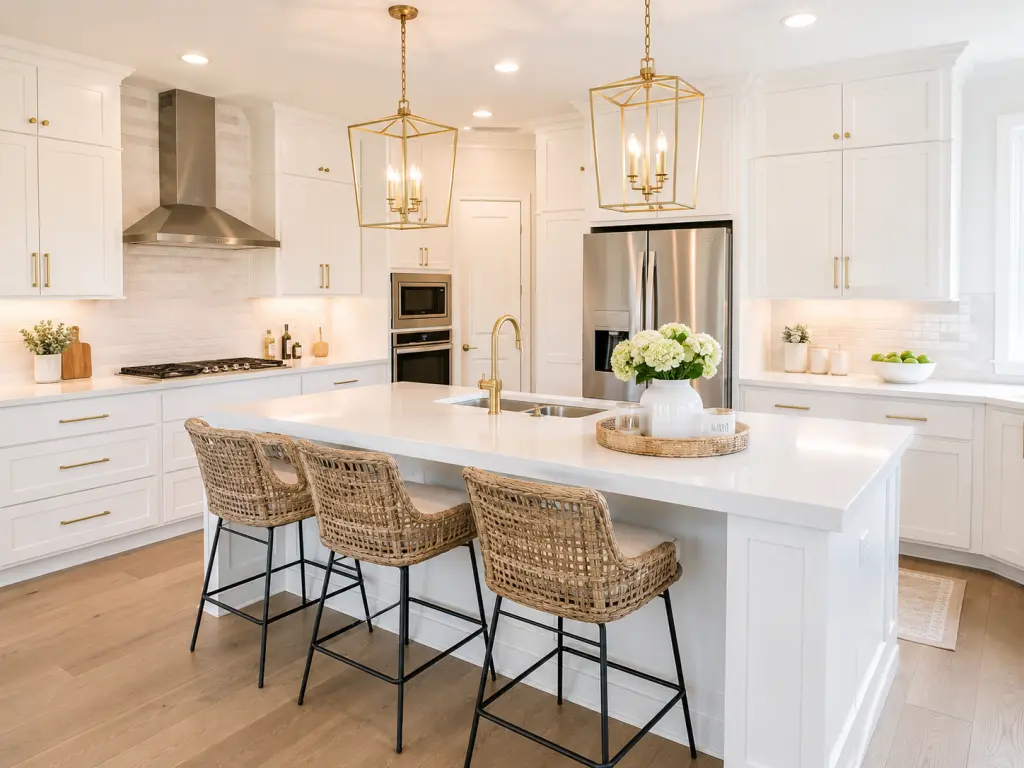
You can accidentally contact quartz with a kitchen knife without immediately ruining the surface, but we do not recommend using the countertop as a cutting board.
Repeated direct cutting can create unnecessary wear, and the quartz can also dull knife blades because the surface is hard.
A separate cutting board offers several advantages. It protects the countertop, is easier to sanitize, keeps food juices contained, and is much easier on knife edges.
Wood, composite, or quality plastic boards are all practical choices.
The point is not that one knife stroke will automatically scratch quartz. It is simply unnecessary to make direct cutting part of the daily routine.
Which objects create the biggest scratch risk?
Heavy objects, rough bottoms, and trapped grit are more concerning than most ordinary kitchenware.
Common sources of damage include ceramic cookware with rough bases, cast-iron pans, decorative pots, appliances with debris underneath, metal tools, sand, and abrasive particles.
The problem is often not the object itself.
For example, a heavy blender may sit safely on quartz for years. But if a hard grain of debris gets trapped underneath and the blender is dragged across the counter, that small particle can act like an abrasive.
This is why lifting appliances and cookware is safer than sliding them.
Can cast iron or heavy cookware scratch quartz?
Yes, especially when rough surfaces or grit are involved.
Cast iron can be heavy and may have a textured underside. Dragging a Dutch oven or skillet across the countertop creates much more friction than simply placing it down.
We recommend using a trivet, silicone mat, or protective pad beneath heavy or hot cookware.
That also helps with another quartz limitation: heat.
Quartz contains polymer binders, so prolonged direct contact with very hot cookware should be avoided. A trivet reduces both heat exposure and abrasive contact at the same time.
Can cleaning products damage the finish?
Yes. Abrasive cleaning tools can create dull or uneven-looking areas even when they do not produce a deep, visible scratch.
This often happens when dried food or residue is attacked with a rough pad or scouring powder.
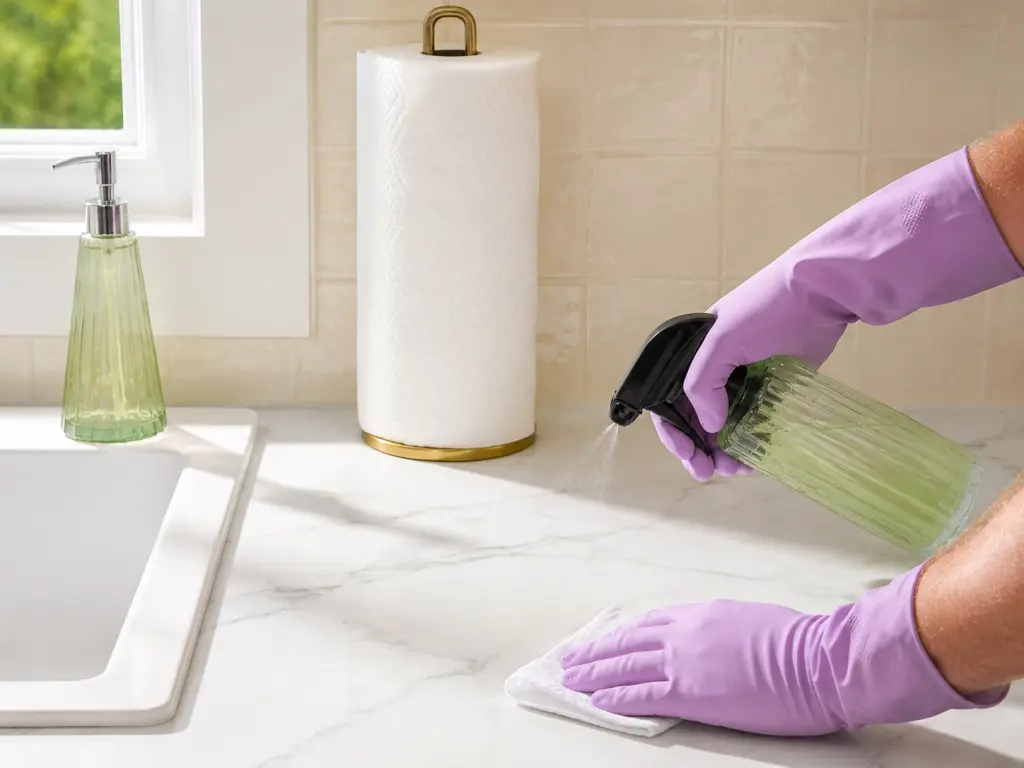
A better approach is to soften the residue first and clean it with warm water, mild dish soap, and a soft microfiber cloth.
Quartz brands such as Cambria, Silestone, Caesarstone, MSI Quartz, and Vicostone may have specific care instructions for individual product lines.
Following the manufacturer’s recommendations for the exact quartz installed is safer than assuming every aggressive household cleaner is appropriate.
Do polished and matte quartz show scratches differently?
Yes. The finish changes how wear becomes visible.
Polished quartz reflects light evenly. A scratch or altered section may interrupt that reflection and become noticeable at certain angles.
Matte quartz may hide some fine lines better, but aggressive rubbing can create areas that appear shinier than the surrounding surface.
Textured quartz can hide certain marks, but residue may collect differently within the finish.
| Finish | What may become more noticeable |
|---|---|
| Polished | Fine scratches and changes in reflection |
| Matte | Burnished areas, oily marks, uneven sheen |
| Textured | Residue or localized wear within texture |
There is no single finish that hides every type of wear.
Are dark quartz countertops more likely to show scratches?
They often show them more clearly.
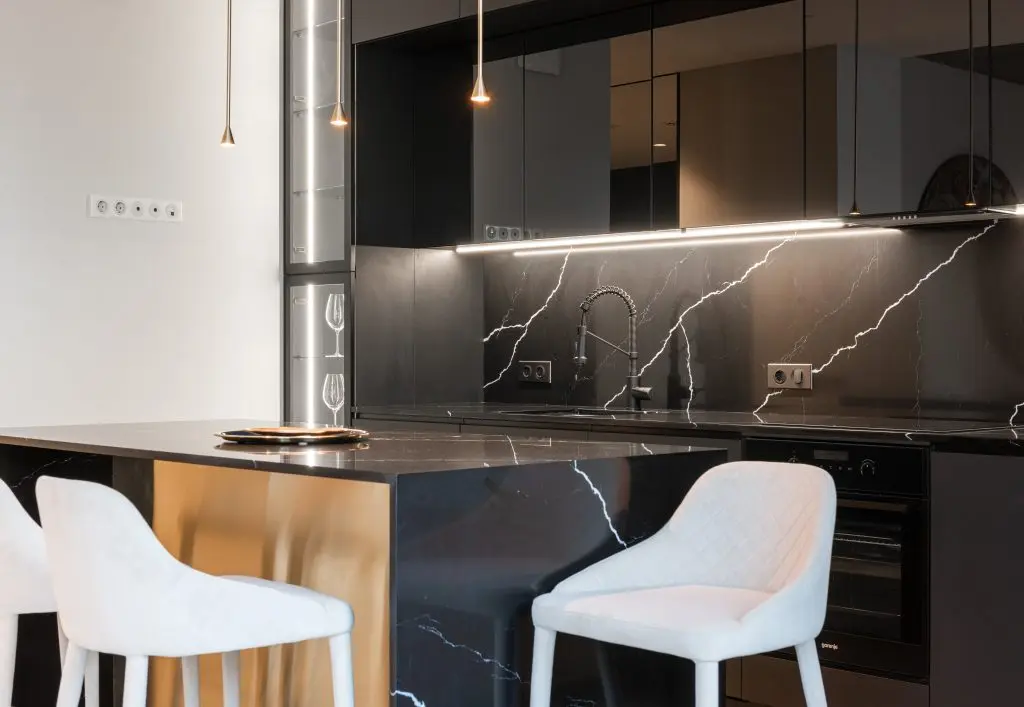
Dark or nearly solid quartz creates more contrast with pale surface marks. A faint scratch that is difficult to notice on a patterned white countertop may stand out more on black or charcoal quartz.
Dark surfaces can also make dust, fingerprints, and dried water spots more visible.
Pattern helps.
Quartz with subtle veining or moderate movement often disguises small daily marks better than a completely solid color.
For heavily used quartz kitchen countertops in Forest Hills, TN, pattern selection can make just as much difference to visual maintenance as the finish itself.
How does quartz compare with granite for scratching?
Both materials are highly scratch-resistant, but their overall maintenance profiles are different.
Granite is a natural stone and commonly measures around 6–7 on the Mohs hardness scale. Quartz also contains very hard mineral content, but its finished slab includes polymer binders.
In daily residential use, both materials can perform extremely well.
Granite generally offers better heat resistance, while quartz offers the advantage of being non-porous and not requiring routine sealing.
That means the decision should not be reduced to which one can survive occasional knife contact. The better choice depends on cooking habits, maintenance preferences, pattern preferences, and heat exposure.
Can a scratched quartz countertop be repaired?
Some minor marks may be improved, but deeper scratches should be evaluated professionally.
Quartz does not behave exactly like natural stone during refinishing. Aggressive sanding or polishing can create a patch with a different sheen, color appearance, or texture.
That risk is particularly noticeable on:
- dark quartz;
- matte finishes;
- bold patterns;
- highly polished surfaces.
Homeowners should avoid trying to grind or polish away scratches unless the manufacturer or an experienced professional recommends the method.
Some marks that look like scratches may also turn out to be residue and become less visible after proper cleaning.
What is the easiest way to prevent scratches?
The best prevention is simple: reduce unnecessary friction.
Use a cutting board for food prep. Lift small appliances rather than sliding them. Put protective pads under rough-bottomed décor or cookware. Use trivets under hot pans. Remove grit before wiping the countertop. Avoid abrasive powders and rough scrubbers.
These habits take very little effort and help preserve the factory finish much more effectively than trying to repair damage afterward.
For a busy household, consistency matters more than complicated countertop care.
How much does quartz cost at Granite Empire of Nashville?
Quartz starts at approximately $58 per square foot.
For comparison, current starting prices are:
| Material | Starting price |
|---|---|
| Granite | From $48/sq. ft. |
| Quartz | From $58/sq. ft. |
| Marble | From $68/sq. ft. |
| Quartzite | Price available upon request |
The final quartz price depends on the selected brand, collection, color, square footage, slab requirements, sink and cooktop cutouts, edge profile, backsplash, seams, custom fabrication, delivery, and installation.
Premium marble-inspired quartz designs can cost more than simpler patterns.
For quartz kitchen countertops in Forest Hills, TN, the full fabricated project quote is more useful than comparing materials only by their starting square-foot price.
Frequently Asked Questions
Can you use quartz as a cutting board?
We do not recommend it. Quartz is highly scratch-resistant, but a cutting board helps protect the surface and prevents unnecessary dulling of your knives.
Can cast iron leave marks on quartz?
Yes, especially if the cookware has a rough bottom or grit is trapped underneath. Lift heavy cookware rather than dragging it and use a protective mat or trivet.
How much do quartz countertops cost at Granite Empire of Nashville?
Quartz starts at approximately $58 per square foot. Final pricing depends on the exact quartz, slab requirements, dimensions, cutouts, edge profile, backsplash, fabrication, and installation.
How long does a quartz countertop project take?
Most projects take approximately 2–3 weeks overall. Fabrication generally requires 7–10 business days after templating, followed by approximately 1–2 days for installation.
Does Granite Empire of Nashville serve Forest Hills, TN?
Yes. Granite Empire of Nashville serves homeowners looking for quartz kitchen countertops in Forest Hills, TN, including quartz selection, professional templating, custom fabrication, sink and cooktop cutouts, edge finishing, delivery, and installation.
Granite Empire of Nashville
4160 Gallatin Pike, Nashville, TN 37216
Phone: (615) 200-1591