
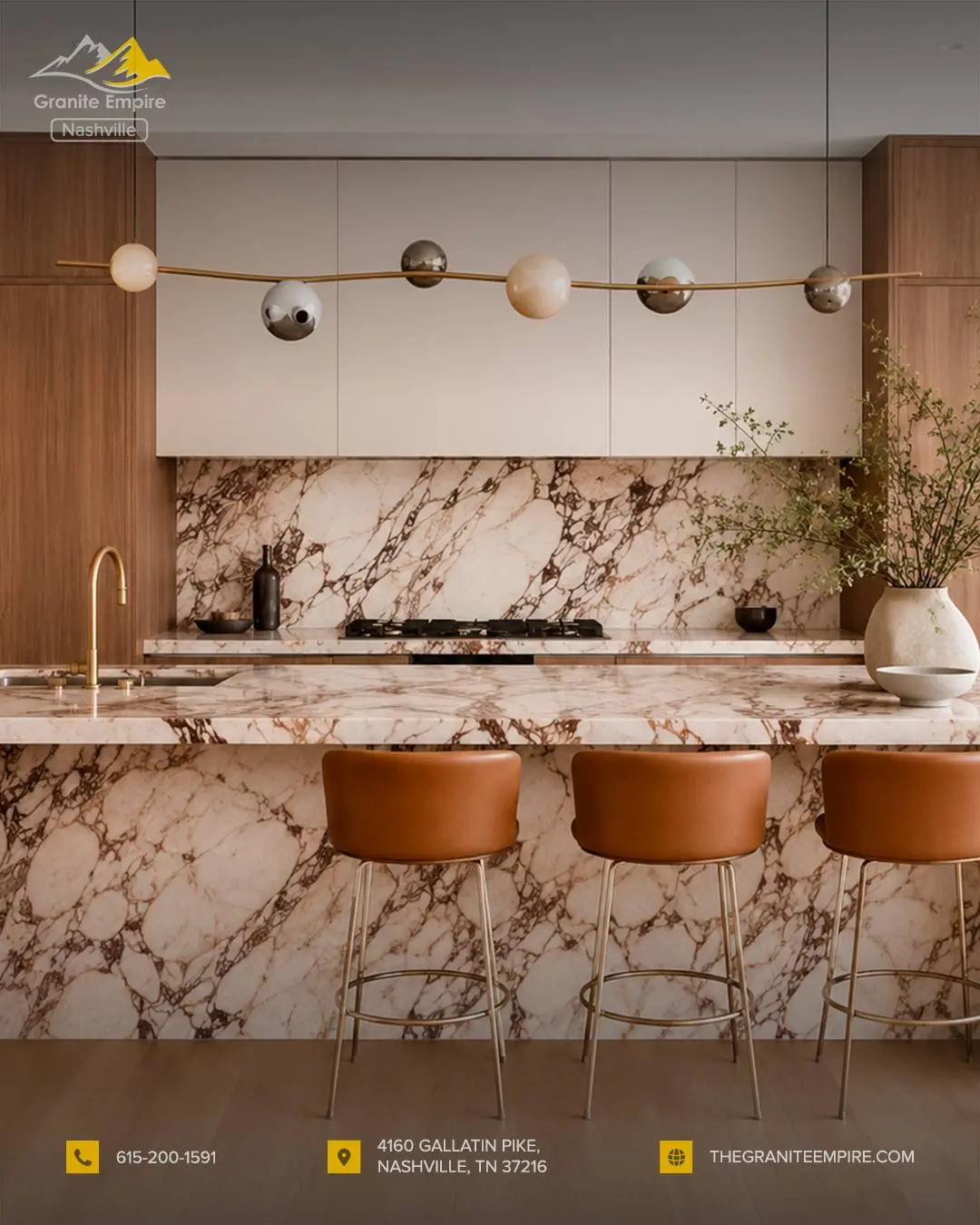
The right choice between a busy and quiet countertop depends on how much visual movement already exists in the kitchen. If your cabinets, flooring, backsplash, and hardware are relatively simple, a dramatic stone can become the focal point. If several surfaces already have strong grain, color, or pattern, a quieter countertop usually creates better balance.
Neither option is automatically more expensive, more durable, or more modern. A dramatic quartzite can be bold and natural, while a subtle granite can feel calm and understated. Quartz can range from nearly solid white to large Calacatta-style veining, and marble can be either softly clouded or highly directional.
At Granite Empire of Nashville, we help homeowners choosing kitchen countertops in Forest Hills, TN compare the entire room before selecting granite, quartz, marble, or quartzite. The goal is not simply finding the most impressive slab. It is choosing the one that makes the finished kitchen work.
What is the difference between a busy stone and a quiet stone?
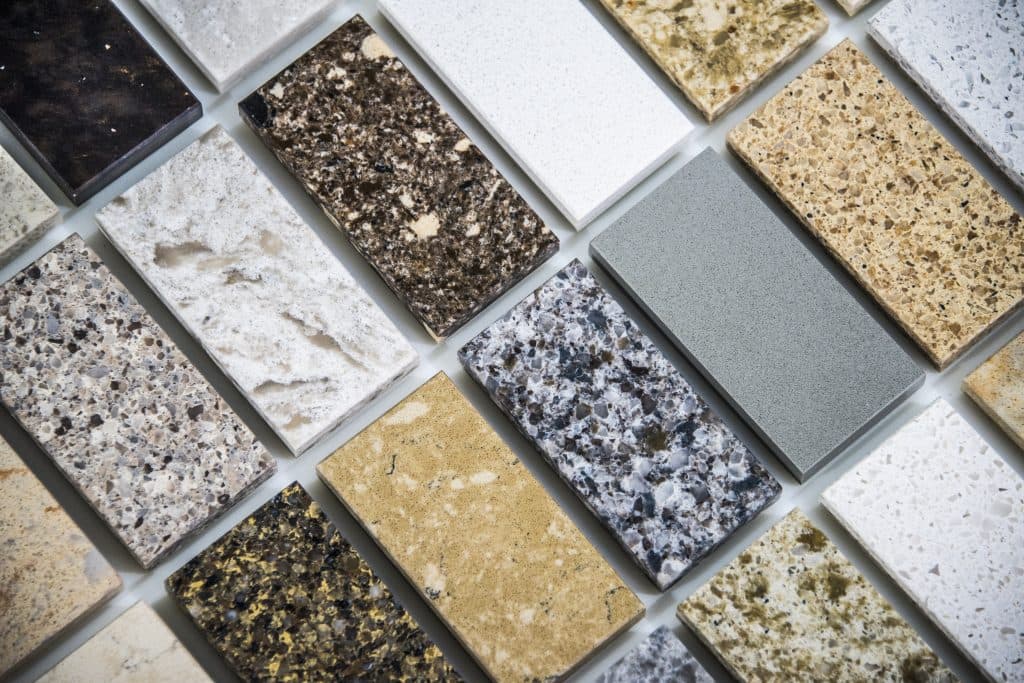
A busy stone has stronger contrast, larger veins, more color variation, or more frequent pattern changes, while a quiet stone has softer and more consistent movement.
Examples of a busy look might include:
- broad gray or gold veining;
- large directional mineral movement;
- several contrasting colors;
- dramatic natural patterns;
- high-contrast backgrounds.
A quiet countertop might have:
- fine speckling;
- subtle cloudy movement;
- thin low-contrast veins;
- nearly solid color;
- evenly distributed mineral pattern.
Busy and quiet are design descriptions, not quality grades.
A subtle granite can be just as durable and valuable as a dramatic slab. Similarly, a highly patterned quartz is not automatically better than a simple one.
When does a busy countertop work best?
A busy countertop works best when the rest of the kitchen gives it enough visual space.
Imagine white or light wood shaker cabinets, simple flooring, plain walls, and a minimal backsplash. A dramatic island can become the feature that gives the kitchen personality.
Busy stone is particularly effective on:
- oversized islands;
- waterfall islands;
- long uninterrupted countertop runs;
- full-height backsplashes;
- kitchens with simple cabinet fronts.
A large surface gives the pattern room to develop.
If a dramatic vein is divided among several short countertop pieces, sink cutouts, and corners, much of its impact can disappear.
For kitchen countertops in Forest Hills, TN, Granite Empire of Nashville recommends looking at the actual slab or full pattern rather than judging bold movement from a small sample.
When is a quiet countertop the better choice?
A quiet countertop is usually better when cabinetry, flooring, or backsplash already carries strong visual texture.
For example, heavily grained wood cabinets combined with patterned flooring and a decorative backsplash already create several focal points.
Adding another bold surface can make the room feel visually crowded.
A quieter countertop can connect those elements without competing with them.
This does not mean the countertop has to be plain. Soft gray movement, light mineral variation, or subtle veining can still make the surface interesting.
Quiet countertops are also useful in smaller kitchens because they create visual continuity across short runs rather than breaking the room into multiple strong patterns.
Which granite patterns feel busy or quiet?
Granite can fall anywhere on the spectrum because natural slabs vary enormously.
Depending on current slab availability, options such as Luna Pearl, New Caledonia, Dallas White, Santa Cecilia, River White, White Ice, Black Pearl, and Steel Gray can create different levels of movement.
Luna Pearl and New Caledonia often provide more distributed mineral patterning, which can read as relatively quiet.
Dallas White can keep a kitchen light while still adding natural texture.
River White and White Ice may show stronger directional movement depending on the individual slab.
Black Pearl and Steel Gray can create a visually calmer surface when the goal is contrast through color rather than dramatic veining.
At Granite Empire of Nashville, granite starts at approximately $48 per square foot.
Is quartz better if you want a controlled pattern?
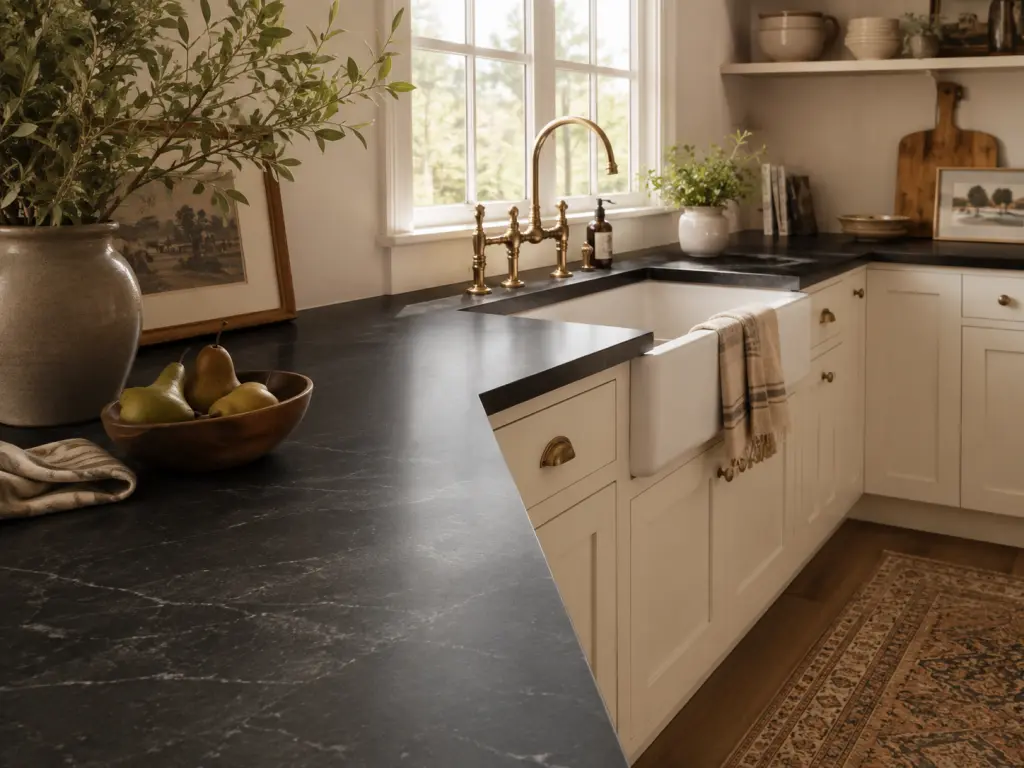
Yes. Quartz gives homeowners more control over pattern, color, and overall consistency.
Brands such as Cambria, Silestone, Caesarstone, MSI Quartz, and Vicostone offer designs ranging from nearly solid colors to dramatic marble-inspired patterns.
A quiet quartz can work well when the kitchen already has:
- wood grain;
- statement tile;
- colorful cabinetry;
- decorative flooring.
A bolder Calacatta-style quartz can work when cabinetry and backsplash are understated.
Quartz also has the practical advantage of being non-porous and not requiring routine sealing.
At Granite Empire of Nashville, quartz starts at approximately $58 per square foot.
The important design question is not whether quartz is busy or quiet. It is whether the scale of the pattern fits the size and layout of the kitchen.
How does marble change the busy-versus-quiet decision?
Marble makes the decision more nuanced because its natural veining can range from delicate to highly dramatic.
Carrara generally creates a softer look with fine gray movement.
Calacatta often produces stronger, broader veins with more contrast.
Statuario can create a highly graphic appearance with bold gray movement against a bright background.
A dramatic marble slab can be stunning on a large island, but it also demands more attention from the rest of the room.
Marble starts at approximately $68 per square foot at Granite Empire of Nashville.
Maintenance also matters. Marble contains calcite and can etch when exposed to lemon juice, vinegar, wine, tomatoes, and other acids. Its pattern may hide some visual wear, but it does not change the material’s maintenance requirements.
Is quartzite a good choice for a statement countertop?
Yes. Quartzite is one of the strongest options when you want dramatic natural movement.
True quartzite commonly has excellent hardness and heat resistance, and many slabs contain broad flowing veins that can become the main design feature of the kitchen.
That makes quartzite particularly effective for:
- large islands;
- open kitchens;
- waterfall panels;
- kitchens with simple cabinets.
However, strong movement makes slab layout more important.
A major vein should not accidentally disappear into a sink cutout or terminate awkwardly at a seam.
At Granite Empire of Nashville, quartzite pricing is available upon request because the exact slab has a major effect on cost.
Should the island be busier than the perimeter countertops?
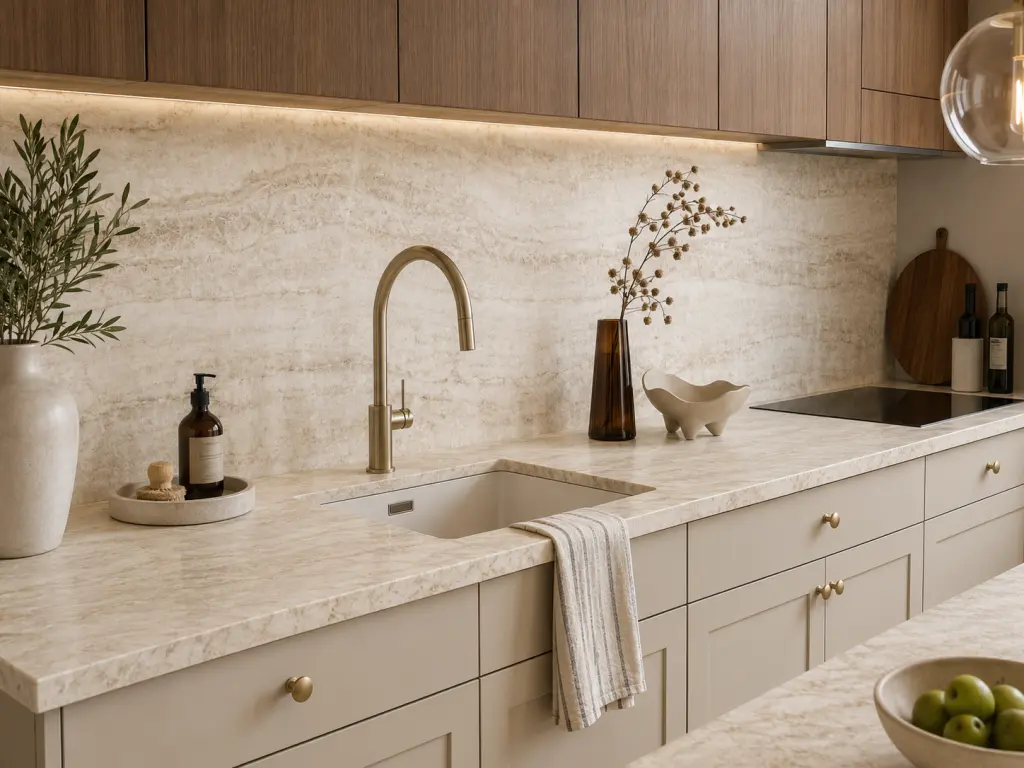
It can be, and this is one of the easiest ways to use a dramatic stone without overwhelming the kitchen.
One common approach is to keep the perimeter quieter and make the island the focal point.
For example:
- subtle quartz perimeter + dramatic quartzite island;
- quiet granite perimeter + bold marble island;
- soft white quartz perimeter + strong Calacatta-style quartz island.
This creates hierarchy.
The eye understands which surface is supposed to stand out instead of seeing every countertop as equally dominant.
Granite Empire of Nashville can also use the same material throughout while reserving the strongest slab movement for the island.
How should cabinets influence the countertop pattern?
The stronger the cabinet grain or color, the more carefully countertop movement should be controlled.
Simple painted cabinets can support almost any countertop style.
Natural wood cabinetry introduces more movement because grain itself is a pattern.
Warm oak, walnut, and heavily figured wood often pair best with stone that contains fewer competing directional lines.
Color matters too.
Dark cabinets with a highly dramatic dark countertop can make a kitchen visually heavy, while a quiet light surface can create contrast.
White or cream cabinets provide more freedom because both subtle and dramatic materials can work.
For homeowners choosing kitchen countertops in Forest Hills, TN, we recommend comparing the actual cabinet door next to the slab instead of relying on separate showroom photos.
What role does the backsplash play?
The backsplash should support the countertop rather than compete with it.
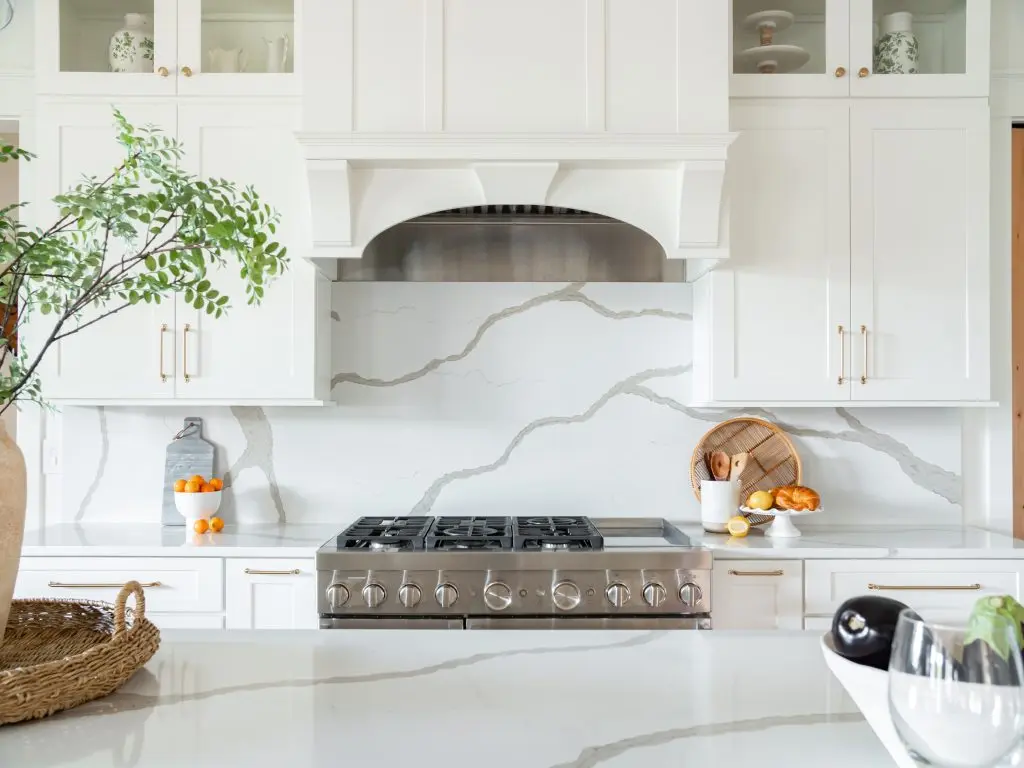
If the countertop has bold veining, a simple backsplash usually creates the cleanest result.
Good options include:
- simple subway tile;
- large-format neutral tile;
- matching slab backsplash;
- low-contrast handmade tile.
If the countertop is quiet, the backsplash can carry more pattern or texture.
One of the most common design mistakes is selecting every surface independently because each one looks attractive alone.
A dramatic granite, patterned tile, heavily grained cabinets, and busy floor may all be beautiful individually but overwhelming together.
How much do the different materials cost?
At Granite Empire of Nashville, current starting prices are:
| Material | Starting price |
|---|---|
| Granite | From $48/sq. ft. |
| Quartz | From $58/sq. ft. |
| Marble | From $68/sq. ft. |
| Quartzite | Price available upon request |
Pattern intensity does not determine price by itself.
A quiet premium quartz may cost more than a dramatic entry-level granite. A rare natural slab may cost more because of quarry availability, movement, and slab quality.
The final project price also depends on square footage, slab requirements, edge profile, sink and cooktop cutouts, seams, backsplash, custom fabrication, delivery, and installation.
How long does countertop fabrication and installation take?
Most Granite Empire of Nashville projects take approximately 2–3 weeks overall.
After final templating, fabrication generally takes 7–10 business days. During that stage, we complete slab layout, pattern placement, sink and cooktop openings, seam planning, and edge fabrication.
Installation usually takes around 1–2 days for a standard kitchen.
Granite Empire of Nashville provides material selection, professional templating, slab-layout planning, custom fabrication, cutouts, edge finishing, delivery, and professional installation.