

The best sink for granite countertops depends on three things — how the kitchen is used, what aesthetic the homeowner is going for, and how the sink will be mounted. Granite is one of the most compatible countertop materials for virtually any sink configuration because its hardness and density handle the structural demands of undermount, drop-in, and farmhouse installations equally well. The decision is primarily about design and function rather than material compatibility.
That said, some sink-and-granite combinations consistently produce better results than others — both visually and practically over years of daily use. At Granite Empire of Nashville, we install granite kitchen countertops in Nolensville, TN and across Middle Tennessee regularly, and the sink conversation is part of every project consultation. Here’s the complete picture.
Why does granite work well with more sink options than other materials?
Granite’s performance characteristics make it unusually compatible across all sink mounting configurations. At Mohs 6 to 7, granite handles heat from hot water and cookware at the sink area without concern — unlike quartz, which can discolor from sustained heat contact near the basin. Its density means the cutout edges around an undermount sink are strong and durable when fabricated correctly. And its natural stone character means it works aesthetically with everything from industrial stainless to artisan fireclay.
Quartz, by comparison, has more specific compatibility considerations — its resin content creates heat sensitivity near the sink, and its engineered uniformity sometimes limits the aesthetic range of sink pairings that read as coherent. Marble works with most configurations but requires more careful cutout edge handling during fabrication. Granite is simply the most forgiving natural stone for sink integration from both a structural and aesthetic standpoint.
This compatibility is part of why granite kitchen countertops in Nolensville, TN and across Middle Tennessee are so frequently paired with a wider variety of sink styles than quartz or marble kitchens.

What are the most popular sink options for granite countertops in 2026?
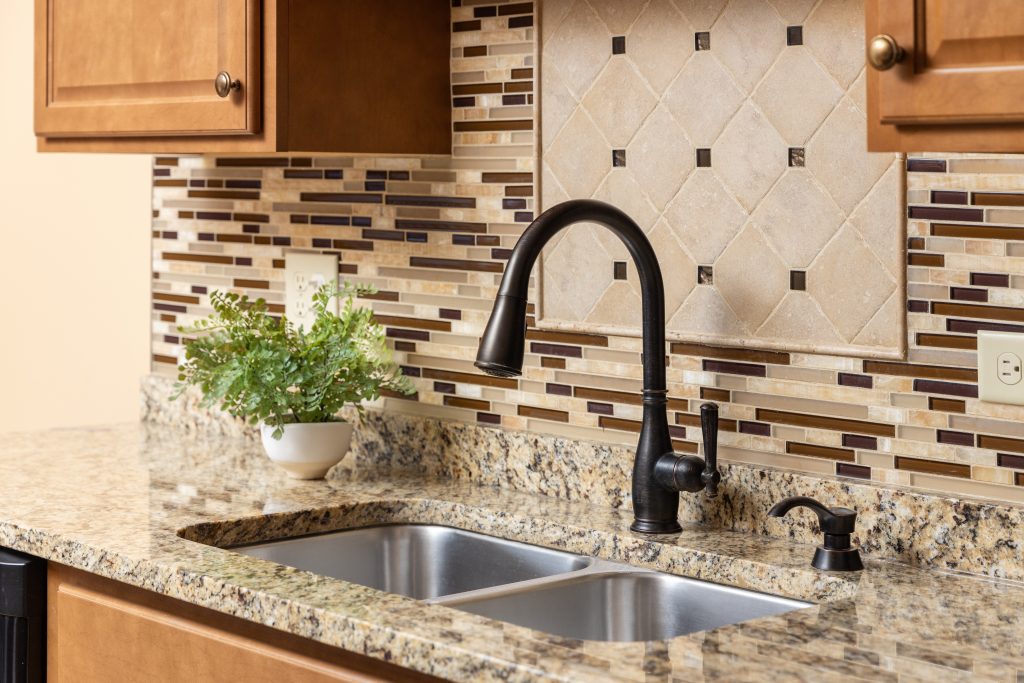
Stainless steel undermount remains the most commonly installed sink configuration with granite countertops — and for straightforward practical reasons. Stainless is durable, heat-resistant, and visually neutral enough to work with virtually any granite color or pattern. The undermount configuration gives granite the cleanest possible visual result — the stone edge is fully exposed, there’s no rim to collect debris, and cleanup is a single wipe from counter to basin.
Gauge matters significantly with stainless undermount sinks. 16-gauge stainless steel is the appropriate specification for a granite kitchen — it’s thick enough to feel solid, resist flexing under load, and dampen sound from running water. 18-gauge is acceptable. 22-gauge or thinner feels lightweight and resonant in a way that doesn’t match the investment quality of a granite countertop. Brands like Kraus, Elkay, and Kohler all offer quality 16-gauge options across a range of configurations and price points.
Composite granite sinks are the most natural pairing for granite countertops from a material harmony standpoint — both are stone-based, both have similar visual weight, and composite granite sinks from brands like Blanco and Franke are available in colors specifically designed to complement granite countertop palettes. These sinks are non-porous, scratch-resistant, and available in a range of finishes from matte black to warm neutrals. They’re heavier than stainless but lighter than fireclay — a practical middle ground that works well with standard cabinet structures.
Fireclay farmhouse sinks are among the most visually impactful choices for granite kitchens where the sink is meant to be a design statement alongside the stone. The apron-front configuration requires specific cabinet modification — the front cabinet panel is removed and the sink’s apron is exposed — but the result is one of the strongest visual combinations available in kitchen design. White fireclay against a darker granite like Absolute Black or Black Pearl creates a high-contrast statement. Warm cream fireclay against a golden granite like Santa Cecilia or Venetian Gold creates a cohesive, warm composition.
Fireclay is heavy — a standard single-basin farmhouse sink weighs 80 to 150 pounds before water is added. This weight is supported by the cabinet structure rather than the granite, but the installation needs to account for it explicitly. At Granite Empire of Nashville, granite starts at $48 per square foot in 2026, and for farmhouse sink installations specifically, we confirm cabinet readiness before templating begins.
Cast iron undermount and drop-in sinks combine the visual warmth of a porcelain finish with cast iron’s durability and weight. They pair particularly well with traditional and transitional granite kitchens — the classic white porcelain surface connects naturally to lighter granite tones, and the substantial feel of cast iron matches the permanence of natural stone. Cast iron is heavy, and like fireclay, cabinet support needs to be confirmed before installation.
How does granite color affect the best sink choice?
The granite’s dominant tone and pattern character are the most useful guides for narrowing sink selection — not as a formula, but as a framework.
Dark granite — Absolute Black, Black Pearl, Nero Assoluto, Ubatuba — creates strong contrast against most sink materials and colors. White fireclay or white cast iron against dark granite is one of the most striking combinations available. Stainless steel against dark granite is clean and modern. Composite granite in black or dark gray against dark granite creates a monolithic, contemporary look that works well in minimalist kitchen designs.
Light granite — Kashmir White, Bianco Romano, Colonial White — is more flexible with sink choice because the light background doesn’t create dominant contrast regardless of sink color. Stainless steel reads as neutral and clean. White fireclay creates a tonal harmony that feels cohesive. Composite granite in warm gray or neutral tones blends smoothly. The risk with light granite and light sinks is that the combination can read as undifferentiated — if distinction is the goal, a darker undermount stainless or a contrasting composite color adds definition.
Warm-toned granite — Santa Cecilia, Giallo Ornamental, Venetian Gold — connects naturally to warm sink materials and finishes. Fireclay in a warm white or cream tone, composite granite in a warm neutral, and stainless with a brushed rather than mirror finish all complement the warmth of these stones without competing.
Highly figured granite — Fusion White, Titanium, Blue Bahia — is already doing significant visual work as the kitchen’s statement surface. A sink that recedes rather than competes is usually the stronger choice — clean stainless undermount, neutral composite granite, or simple white fireclay that supports the stone without adding another dramatic element.
| Granite Type | Best Sink Options | Visual Result |
|---|---|---|
| Dark (Absolute Black, Black Pearl) | White fireclay, stainless, dark composite | High contrast or monolithic |
| Light (Kashmir White, Bianco Romano) | Stainless, white fireclay, neutral composite | Clean, cohesive |
| Warm-toned (Santa Cecilia, Venetian Gold) | Warm fireclay, warm composite, brushed stainless | Warm, layered |
| Highly figured (Fusion White, Blue Bahia) | Simple stainless, neutral composite | Stone leads, sink supports |
What practical details should be confirmed before fabrication?
Several sink-specific details need to be locked in before the template appointment — because the cutout dimensions, faucet hole placement, and cabinet modifications required for the sink are all fabricated into the stone before installation day.
Sink model confirmation is the most critical step. The fabricator needs the exact sink dimensions and cutout specifications before templating. Having the physical sink on-site at the template appointment is ideal — having the confirmed model number and spec sheet is the minimum requirement.
Faucet hole configuration needs to match the faucet selected. A single-hole faucet requires one cutout, a widespread three-hole faucet requires three holes at specific spacing. This must be specified before fabrication — drilling additional holes after installation is possible but adds cost and risk.
Cabinet modification for farmhouse sinks needs to be completed before the template appointment. The apron front configuration changes the countertop’s front overhang dimensions, and the template must reflect the actual installed cabinet configuration.
For anyone finalizing plans for granite kitchen countertops in Nolensville, TN, Granite Empire of Nashville serves Nolensville and Williamson County from our Nashville showroom. Sink specification review is part of every project consultation — our team walks through the sink model, faucet configuration, and mounting type before the template appointment so nothing gets missed during fabrication. Most projects are completed within two to three weeks from template to installed countertops. Reach us at (615) 200-1591 or visit us at 4160 Gallatin Pike, Nashville, TN 37216.