
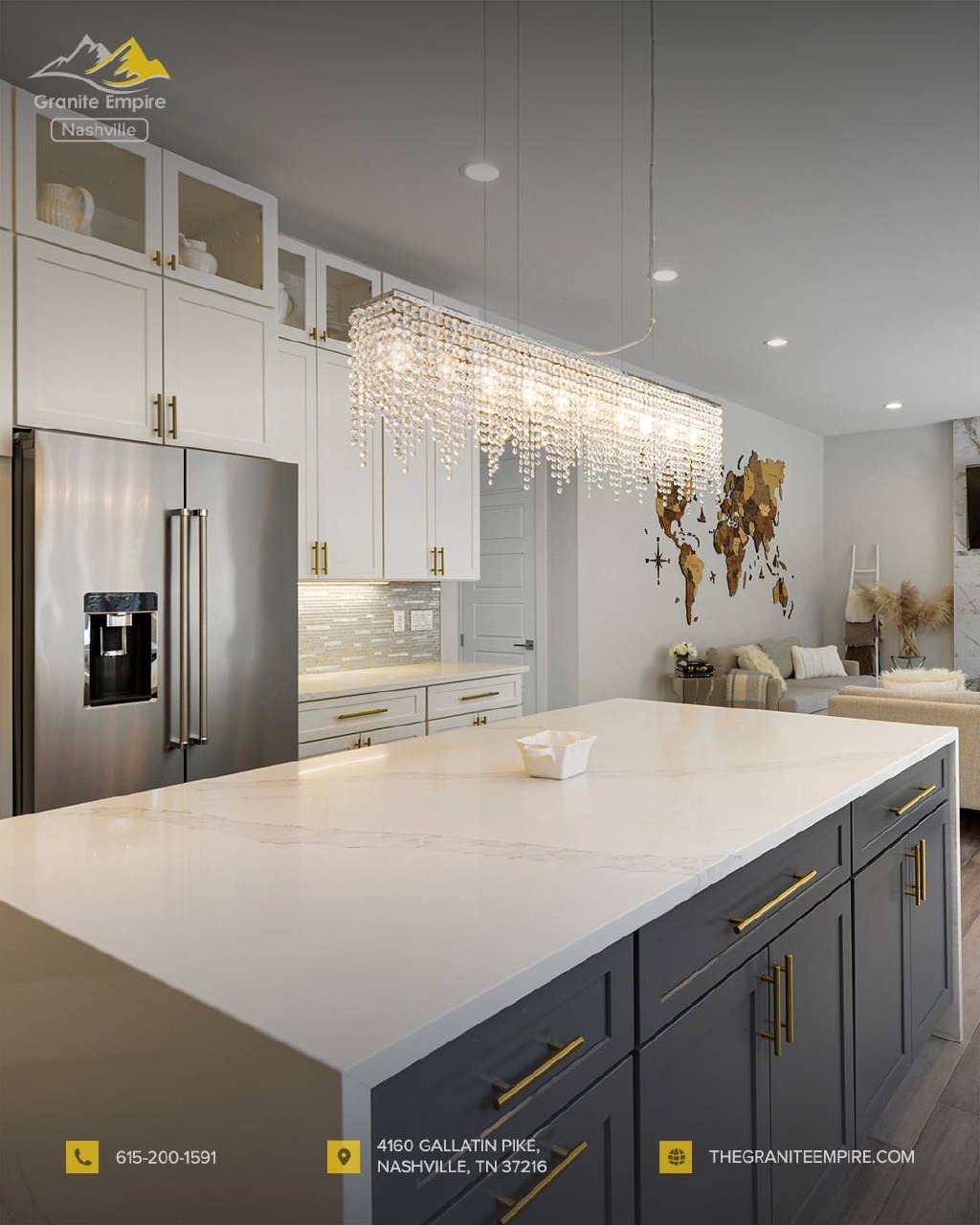
Most homeowners see two moments in the countertop process — the slab selection and the installed result. Everything that happens between those two moments is largely invisible, which is part of why fabrication quality is so difficult to evaluate from a quote alone. The cutting, edging, polishing, and preparation work that transforms a raw stone slab into a finished countertop ready for installation involves specialized equipment, material-specific techniques, and skilled labor that takes years to develop.
Understanding what actually happens in a fabrication shop doesn’t make every homeowner an expert — but it does help explain why two quotes for “the same kitchen in the same material” can produce genuinely different results, and what questions are worth asking before committing to a fabricator.
At Granite Empire of Nashville, as one of the leading countertop fabricators in Nolensville, TN and across Middle Tennessee, fabrication happens in-house on every project. Here’s what that process actually involves.

What happens during the template appointment?
The fabrication process begins at the template appointment — not in the shop. A technician visits the home with templating equipment and creates a precise record of every dimension, angle, cutout location, and edge detail that the fabricated countertop needs to match.
Traditional templating used physical templates — strips of thin material cut to the exact countertop shape and brought back to the shop as cutting guides. Most professional fabricators in 2026 use digital templating systems — laser measuring devices that capture precise three-dimensional data and transmit it directly to the shop’s CNC cutting software. Digital templating is more accurate, faster, and reduces the risk of measurement errors that can require expensive remakes.
The template appointment is also when final decisions are confirmed — sink model, faucet hole placement, edge profile selection, and seam locations. These decisions need to be locked in before fabrication begins because changing any of them after cutting starts requires either restarting the fabrication or accepting a compromised result.
Template data accuracy is the foundation of fabrication quality. A countertop fabricated to slightly inaccurate measurements will either have gaps at the wall, overhangs that vary across the run, or seams that don’t align correctly. Experienced templaters understand how to account for walls that aren’t perfectly straight, corners that aren’t exactly 90 degrees, and cabinets that vary slightly in height across their length — all of which are normal conditions in real kitchens.
How is the slab cut and shaped?
Once template data is in the shop, the fabrication team plans the cut layout — deciding how the pieces for the project will be positioned within the slab to minimize waste, optimize pattern continuity at seams, and ensure that the most visually attractive parts of the slab land in the most prominent positions.
For countertop fabricators in Nolensville, TN customers with natural stone selections — granite, marble, quartzite — this layout planning step is consequential. The veining and movement of a natural stone slab is not uniform, and where a cut lands within the slab determines how the pattern reads in the finished countertop. A skilled fabricator plans cuts that put the most attractive slab sections in the highest-visibility locations — typically the island front, the main prep area, and any full-height backsplash sections.
The primary cutting tool is a bridge saw — a large industrial saw with a diamond-tipped blade that moves on a calibrated gantry above the slab. Bridge saws cut straight lines precisely and are used for the main sizing cuts that bring slab sections down to approximate counter dimensions. Modern CNC-controlled bridge saws can execute complex cut sequences automatically from digital template data, improving precision and consistency over manual operation.
For curves, sink cutouts, and other non-linear cuts, fabricators use CNC routers with diamond tooling — computer-controlled cutting heads that follow programmed paths with high precision. A CNC router cuts the undermount sink opening, rounds corners to the specified radius, and executes any custom shape required by the design. The precision of CNC routing is why undermount cutout edges on a professional installation look clean and consistent — the machine follows the same path every time rather than depending on hand-cutting skill.

How do edge profiles get fabricated?
Edge profiles are one of the most visible elements of fabrication quality — and one of the most technically variable. The same edge profile specification can look substantially different depending on the equipment used and the skill of the operator.
Edges are shaped using CNC profile machines — specialized equipment with rotating diamond tooling heads calibrated to specific profile geometries. An eased edge requires a simple pass that softens the top corner. A half bullnose requires a curved tooling head. An ogee requires a complex S-curve profile that involves multiple tooling passes to achieve the correct geometry.
Material density affects edge fabrication significantly. Granite at Mohs 6 to 7 is dense and consistent — edges profile cleanly and hold their geometry well. Marble at Mohs 3 to 4 is softer and more prone to chipping at thin edge sections during profiling, which requires slower cutting speeds, more careful tooling pressure, and more experienced operators. This is part of why marble fabrication is generally priced higher than granite at the same square footage — the additional care required is real.
After profile cutting, edges go through a polishing sequence — a series of progressively finer abrasive pads that bring the edge surface from rough-cut to match the finish of the top surface. For a polished finish, this sequence may involve eight to twelve polishing steps. For a honed finish, the sequence stops earlier. For a leathered finish, textured brushing tooling is used after the initial honing stage.
At Granite Empire of Nashville, granite starts at $48 per square foot, quartz at $58, and marble at $68 in 2026 — and the edge fabrication quality included in those prices reflects in-house work on professional CNC equipment rather than outsourced or hand-cut edges.
What happens during the final polishing and quality check?
After cutting, edge profiling, and seam preparation, the finished countertop sections go through a final polish and inspection before leaving the shop.
Final polishing ensures that the top surface matches the specified finish consistently across the entire piece — that no tooling marks from the cutting process remain visible, that the edge finish matches the surface finish, and that any areas requiring touch work after cutouts or seams are addressed before the stone reaches the installation site.
Quality inspection checks dimensions against the original template, confirms that cutout positions are correct, verifies seam fit by placing mating pieces together, and reviews edge finish quality across the full perimeter. Any piece that doesn’t meet the shop’s quality standard is corrected before it leaves — because corrections at the shop are straightforward, while corrections after installation range from difficult to impossible.
For anyone looking for countertop fabricators in Nolensville, TN, Granite Empire of Nashville serves Nolensville and Williamson County from our Nashville location. Every project is fabricated in-house with CNC equipment and reviewed against quality standards before installation day. Most projects are completed within two to three weeks from template to installed countertops. Reach us at (615) 200-1591 or visit us at 4160 Gallatin Pike, Nashville, TN 37216.
Frequently Asked Questions
What happens during stone countertop fabrication?
Fabrication transforms a raw stone slab into finished countertop sections ready for installation. The process includes template measurement, cut layout planning, bridge saw cutting, CNC router work for sink cutouts and curves, edge profile machining through multiple diamond tooling stages, seam preparation and pattern matching, surface and edge polishing, and final quality inspection before the stone leaves the shop.
How long does countertop fabrication take at Granite Empire of Nashville?
Fabrication runs five to seven business days after the template appointment for most standard kitchen projects. Complex projects — waterfall edges, extensive seam matching on heavily veined stone, or unusual cutout configurations — may add one to three business days to the fabrication window. Most projects are completed within two to three weeks from first contact to installed countertops.
How much do countertops cost at countertop fabricators in Nolensville, TN in 2026?
At Granite Empire of Nashville, granite starts at $48 per square foot, quartz at $58, and marble at $68 in 2026. In the Nashville area, installed countertop costs typically range from $50 to $150 per square foot depending on material and complexity. For a standard kitchen of 40 to 50 square feet, most projects fall between $2,000 and $6,500 fully installed.
Why does marble fabrication cost more than granite?
Marble sits at Mohs 3 to 4 — significantly softer than granite at Mohs 6 to 7. Its lower hardness makes edge profiling more prone to chipping at thin sections, requiring slower cutting speeds, more careful tooling pressure, and more experienced operators. Cutout edges require additional care for the same reason. This additional fabrication time and skill is reflected in marble’s higher per-square-foot price compared to granite at the same shop.
Does Granite Empire of Nashville serve Nolensville, TN?
Yes. We serve Nolensville and Williamson County from our Nashville showroom at 4160 Gallatin Pike, Nashville, TN 37216. We have no separate office in Nolensville, but we work with homeowners there regularly. Call us at (615) 200-1591 to schedule a visit or discuss your countertop project.