

Countertop seams are made as unobtrusive as possible through careful slab layout, precise cutting, tight joint preparation, color-matched adhesive, proper leveling, and thoughtful seam placement. A good seam should be structurally sound first and visually discreet second. It may never become literally invisible, especially in strongly veined natural stone, but experienced fabrication can make it blend naturally into the countertop.
The biggest difference usually happens before installation. If the seam is placed in the wrong location or cuts directly across dramatic movement, even excellent adhesive cannot fully hide it. Pattern, slab size, sink position, cabinet support, and access to the home all affect where seams should go.
At Granite Empire of Nashville, we help homeowners working with countertop fabricators in Forest Hills, TN plan granite, quartz, marble, and quartzite layouts before cutting begins.
Why do some countertops need seams at all?
Countertops need seams when the finished layout is larger than the usable slab, too difficult to transport in one piece, or structurally safer to install in sections.
Natural stone slabs and engineered quartz slabs come in fixed dimensions. A long L-shaped kitchen, oversized island, or large perimeter layout may simply exceed those dimensions.
Even when one piece technically fits on a slab, moving it into the home can become a problem.
Doorways, hallways, staircases, tight corners, and large sink or cooktop cutouts can make a very large piece difficult or unsafe to carry. A section with a big cutout may also become vulnerable during transport.
A planned seam is often better than forcing one enormous piece and risking breakage.
Where should countertop seams be placed?
The best seams are placed where they have strong cabinet support and create the least visual disruption.
Good seam locations often include straight countertop runs with solid support underneath. Poor locations may include unsupported overhangs, weak narrow sections, or visually prominent areas where a dramatic vein is interrupted awkwardly.
We also consider:
- cabinet joints;
- sink location;
- cooktop location;
- corners;
- island orientation;
- slab dimensions;
- pattern direction;
- traffic and viewing angles.
A seam next to a sink is not automatically wrong, but the surrounding stone must remain structurally appropriate.
For homeowners comparing countertop fabricators in Forest Hills, TN, asking where seams will go before fabrication is one of the most useful questions you can ask.
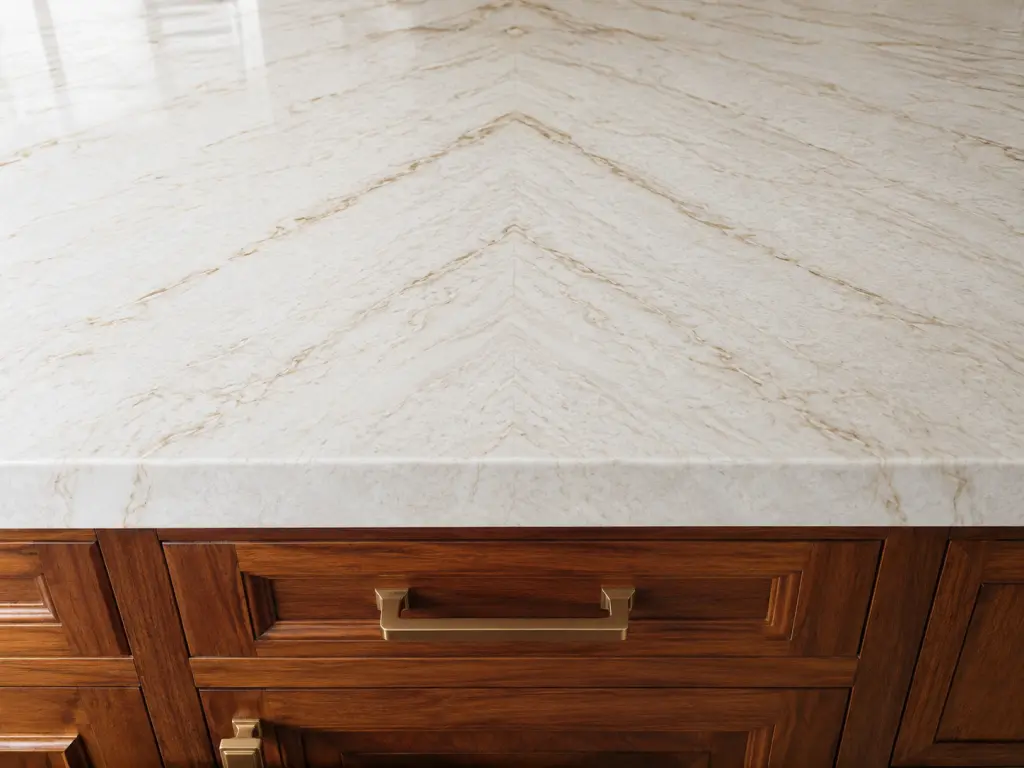
How are granite seams made less visible?
Granite seams are minimized through precise cutting, careful slab matching, and adhesive tinted to coordinate with the stone.
Natural granite does not have a repeating manufactured pattern. Every slab contains different mineral movement, so the fabricator has to decide which parts should meet.
Granites such as Luna Pearl, New Caledonia, Dallas White, Santa Cecilia, and Black Pearl often have more distributed patterns. That can make seams easier to disguise because there is less dramatic directional movement to align.
Stones such as River White or White Ice may show stronger movement, so the seam needs more careful planning.
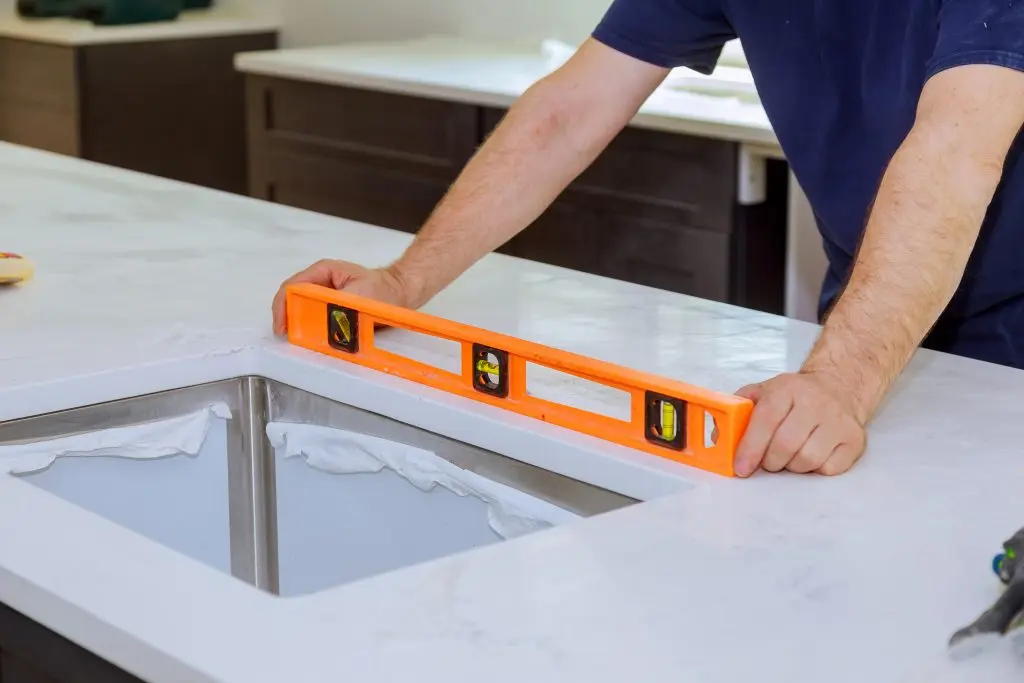
After the pieces are positioned, a color-matched seam adhesive is used to join them. The joint is tightened and leveled so one side does not sit higher than the other.
A well-made granite seam should feel relatively smooth under the hand and should not create a distracting ridge.
Are quartz seams easier to hide than granite seams?
Sometimes. Quartz patterns are more predictable, but dramatic quartz designs can actually make seam matching very demanding.
Solid or lightly patterned quartz is usually straightforward because there is less movement to interrupt.
Bold Calacatta-style quartz is different.
Brands such as Cambria, Silestone, Caesarstone, MSI Quartz, and Vicostone produce designs with large gray, gold, or charcoal veins. If a seam cuts through one of those veins, the transition needs to be planned carefully.
The challenge is that engineered quartz patterns are controlled but not infinitely adjustable. The fabricator still has to work with the actual slab dimensions and layout.
A large island may look better with no seam if the slab size allows it. On longer runs, a seam may be unavoidable.
Can marble and quartzite seams be matched well?
Yes, but strongly veined marble and quartzite require more planning than subtle stone.
Marble such as Carrara, Calacatta, and Statuario can contain long directional veins. Quartzite can show similarly dramatic movement.
The goal is not always to make the pattern look identical at the seam. Sometimes that is impossible.
Instead, the fabricator tries to create a transition that looks intentional.
That may involve rotating a template, shifting the cut location, or choosing adjacent sections of the slab so the vein direction continues naturally.
Highly dramatic stone can require more waste because the best visual layout may not be the most material-efficient layout.
This is one reason premium slab work can cost more than a simple square-foot calculation suggests.

What makes a seam look bad?
Visible gaps, poor color matching, uneven height, awkward vein interruption, and bad seam placement are the most common reasons a seam stands out.
A seam may look poor when:
- the adhesive color contrasts with the stone;
- the joint is too wide;
- one countertop section sits higher than the other;
- strong veins stop abruptly;
- the seam falls in a highly visible focal area;
- the cabinet support below is uneven;
- the pieces were not cut cleanly.
Lighting can also make seams look more visible.
Under-cabinet lights or sunlight hitting the surface at a low angle can reveal even a well-made joint more clearly than normal overhead lighting.
The realistic goal is therefore not “zero visibility.” It is a seam that does not distract from the countertop.
Does seam width depend on the material?
Yes. Material characteristics and fabrication quality both affect the final joint.
Natural stone can contain slight dimensional variation, while engineered quartz is more uniform. Still, every seam depends on accurate cutting and proper installation.
The edge of each piece must be prepared so the two surfaces come together closely.
Color-matched adhesive then fills the remaining joint.
The best seam is narrow enough to be visually discreet but still properly filled and bonded.
Trying to force pieces together without enough adhesive is not a sign of quality. Structural integrity matters just as much as appearance.
Can a large kitchen island avoid seams completely?
Often, yes—if the island fits safely within one slab and can be transported into the home.
Large islands are one of the main reasons slab size matters.
An 8-foot island may fit within many granite or quartz slabs. A 10-foot island, unusually deep island, or waterfall design may push the project beyond one usable slab.
Sink and cooktop cutouts also matter. A single large piece with a major opening can become more fragile during transport.
At Granite Empire of Nashville, we look at the actual slab dimensions before promising a seamless island.
For Forest Hills, TN projects, access into the home matters too. A slab that fits on paper still has to move safely through doors and around corners.
How much do different countertop materials cost?
At Granite Empire of Nashville, our current starting prices are:
| Material | Starting price |
|---|---|
| Granite | From $48/sq. ft. |
| Quartz | From $58/sq. ft. |
| Marble | From $68/sq. ft. |
| Quartzite | Price available upon request |
Seam complexity can affect the final project price, especially when strong pattern matching or additional slab material is required.
A simple granite with distributed movement may be easier to seam than a dramatic marble or quartzite with long directional veins.
The final cost also depends on square footage, slab selection, edge profile, sink and cooktop cutouts, backsplash, fabrication complexity, delivery, and installation.
How long does countertop fabrication and installation take?
Most Granite Empire of Nashville projects take approximately 2–3 weeks overall.
After final templating, fabrication usually takes 7–10 business days. During this stage, we plan slab layout, determine seam locations, create sink and cooktop cutouts, fabricate edges, and prepare each piece for installation.
Installation usually takes approximately 1–2 days for a standard project.
Our services include material selection, professional templating, slab layout, seam planning, custom fabrication, cutouts, edge finishing, delivery, and professional installation for customers in Forest Hills, TN and the surrounding area.
Frequently Asked Questions
Can countertop seams be completely invisible?
Not usually. The goal is to make them as discreet as possible. Precise cutting, color-matched adhesive, good leveling, and smart placement can make a seam difficult to notice, but natural pattern variation may still reveal it.
Which countertop material has the least visible seams?
Solid or subtly patterned quartz is often easiest to seam visually because the pattern is consistent. Strongly veined quartz, marble, granite, and quartzite require more careful matching.
How much do countertops cost at Granite Empire of Nashville?
Granite starts at approximately $48 per square foot, quartz at $58 per square foot, and marble at $68 per square foot. Quartzite pricing is available upon request. Final pricing depends on material, slab requirements, fabrication, seams, cutouts, and installation.
How long does countertop fabrication take?
Fabrication typically takes 7–10 business days after templating, followed by approximately 1–2 days for installation. Most projects are completed in around 2–3 weeks overall.
Does Granite Empire of Nashville serve Forest Hills, TN?
Yes. Granite Empire of Nashville serves homeowners looking for countertop fabricators in Forest Hills, TN, providing granite, quartz, marble, and quartzite selection, professional templating, slab layout, seam planning, custom fabrication, delivery, and installation.
Granite Empire of Nashville
4160 Gallatin Pike, Nashville, TN 37216
Phone: (615) 200-1591