
Yes, honed granite may need sealing more often than polished granite, but not because honing makes every slab dramatically more porous. The difference is that a honed finish is mechanically ground to a smooth matte surface instead of being polished to a glossy, more tightly finished surface. Depending on the granite, this can make oils, water, fingerprints, and dark moisture marks more noticeable and may allow some liquids to penetrate more readily.
The actual sealing schedule still depends on the specific stone, not just the finish. Dense granite may need very little maintenance even when honed, while a lighter, more absorbent slab can require more frequent attention.
At Granite Empire of Nashville, we help homeowners visiting granite stores in Millersville, TN compare polished, honed, and leathered granite based on appearance, porosity, maintenance, and daily kitchen use before custom fabrication and installation.
Why can honed granite need more frequent sealing?
Honed granite can need more frequent sealing because the finishing process leaves the surface less highly polished and sometimes more receptive to liquids and oils.
Polished granite goes through progressively finer abrasives until the surface becomes glossy and reflective. That process creates a smoother finish and can reduce how readily some liquids interact with the surface.
Honed granite stops earlier in the finishing sequence, leaving a matte or satin appearance.
That softer look is one of the reasons homeowners choose it, especially in kitchens with:
- natural wood cabinets;
- matte hardware;
- textured backsplashes;
- warm neutral colors;
- modern or transitional design.
The tradeoff is that some honed granites can show dark marks from water or oil more clearly than the same stone in a polished finish.
This is why sealing matters more as part of the maintenance conversation.
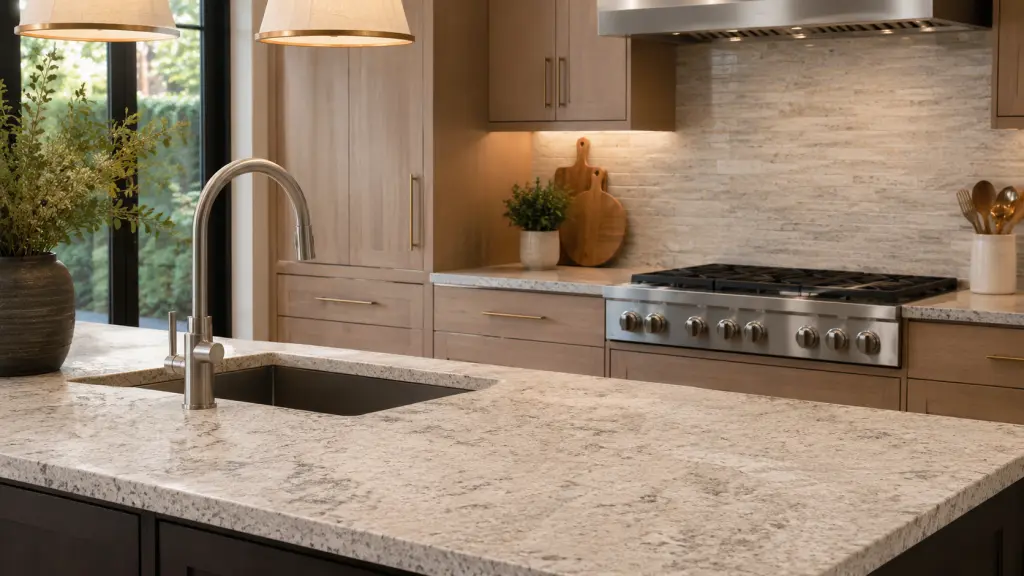
Does honed granite absorb more water than polished granite?
Sometimes, yes, although the exact difference depends on the stone.
Granite is a natural material made from minerals such as quartz and feldspar. It generally measures around 6–7 on the Mohs hardness scale, but hardness and absorption are different properties.
A dense dark granite may absorb very little water regardless of finish. A lighter or naturally more porous granite may darken more readily when liquid sits on the surface.
Honing can make that darkening more noticeable because the finish is less reflective.
Granites such as Dallas White, River White, White Ice, Luna Pearl, New Caledonia, Black Pearl, and Steel Gray can all behave differently.
This is why we do not recommend one universal sealing schedule for every granite.
For homeowners comparing granite stores in Millersville, TN, the specific slab should be evaluated instead of assuming all honed granite requires the same care.
How often should honed granite be sealed?
Honed granite should be resealed when the stone begins absorbing liquid faster than it should, not simply because a calendar says one year has passed.
Some honed granite countertops may benefit from resealing every year or two, while dense stones may go much longer.
The interval depends on:
- natural porosity;
- granite color and mineral structure;
- type of sealer used;
- quality of the original application;
- frequency of cooking;
- oil exposure;
- cleaning products;
- amount of water exposure.
A simple water test can help.
Place a small amount of water on a clean section of granite and let it sit for approximately 10–15 minutes. If the area darkens noticeably after the water is wiped away, the surface may be absorbing moisture and could be ready for resealing.
The darkening should fade as the stone dries if it is only temporary moisture.
Does honed granite stain more easily?
It can, especially with oil, but the actual staining risk depends heavily on the granite and the quality of the sealer.
Cooking oil is one of the biggest concerns.
Olive oil, butter, salad dressing, grease, and oily sauces can create darker areas if they penetrate the stone. On honed granite, these marks may stand out more because the overall surface has a soft matte appearance.
Water can also temporarily darken certain stones.
The good news is that proper sealing gives homeowners more time to clean spills before they absorb.
A sealer does not make granite completely waterproof or stain-proof. It slows absorption.
For a working kitchen, we recommend wiping oil, wine, coffee, sauces, and strongly colored liquids promptly rather than depending on the sealer to do all the work.
Is polished granite easier to maintain?
Generally, yes. Polished granite is usually the easiest granite finish to maintain in a busy kitchen.
Its smooth reflective surface tends to be easier to wipe clean, and fingerprints, oil marks, and temporary moisture darkening may be less noticeable depending on the stone.
That does not mean polished granite is maintenance-free.
Natural granite may still need periodic sealing, especially around:
- sinks;
- prep areas;
- cooktops;
- coffee stations;
- frequently used islands.
The difference is mostly one of visibility and absorption behavior.
A homeowner who wants the simplest everyday maintenance may prefer polished granite. Someone who strongly prefers the softer appearance of honed stone may consider the small increase in maintenance completely worthwhile.
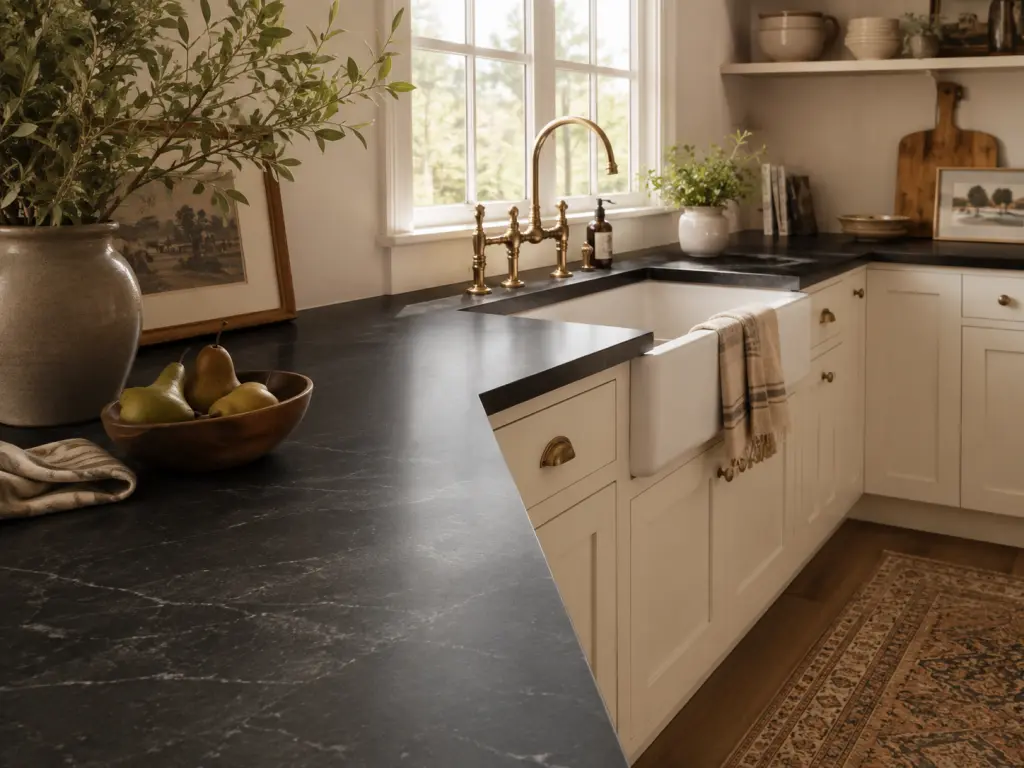
What about leathered granite?
Leathered granite falls between honed and polished in appearance but has its own maintenance characteristics.
A leathered finish creates a textured, low-sheen surface that emphasizes natural mineral structure.
It can be particularly attractive in darker stones such as Black Pearl or Steel Gray because the texture adds depth without creating a mirror-like shine.
Leathered granite may hide fingerprints better than polished stone, but its texture can collect residue in small surface variations if cleaning is neglected.
Like honed granite, it may require sealing depending on the specific stone.
| Finish | Appearance | Main maintenance concern |
|---|---|---|
| Polished | Glossy and reflective | Periodic sealing on some stones |
| Honed | Smooth matte or satin | Water and oil marks may show more |
| Leathered | Textured, low-sheen | Residue can collect in texture |
The right finish should therefore be selected based on both design preference and how the kitchen will actually be used.
Does granite color affect how often it needs sealing?
Yes. Granite color can give clues about density and porosity, although color alone should never be the only test.
Many dark granites are relatively dense and absorb very little moisture. Some lighter granites can be more porous and may benefit from more regular sealing.
That does not mean every black granite needs no sealer or every white granite needs frequent resealing.
The individual slab matters.
For example, two Dallas White slabs may have different absorption characteristics depending on quarry variation and mineral structure.
The practical approach is to test the stone and follow professional guidance rather than relying on a rule such as “seal every 12 months.”
How should honed granite be cleaned?
Honed granite should be cleaned with a pH-neutral stone cleaner or mild dish soap and warm water.
Avoid unnecessarily harsh chemicals and abrasive cleaning products.
Abrasive powders and rough pads can change the appearance of the finish over time. Acidic cleaners such as vinegar are also unnecessary for granite care and may affect certain sealers.
For everyday maintenance:
- wipe spills promptly;
- use a soft microfiber cloth;
- clean oily residue rather than allowing it to sit;
- dry standing water around sinks;
- use cutting boards;
- use trivets near hot cookware.
Granite handles heat extremely well, but trivets still help protect the sealer and keep cookware residue away from the surface.
How does granite compare with other countertop materials for maintenance?
Granite offers a strong balance between natural beauty, heat resistance, durability, and manageable maintenance.
At Granite Empire of Nashville, current starting prices are:
| Material | Starting price | Maintenance |
|---|---|---|
| Granite | From $48/sq. ft. | May require periodic sealing |
| Quartz | From $58/sq. ft. | No routine sealing |
| Marble | From $68/sq. ft. | Sealing plus acid protection |
| Quartzite | Price available upon request | Usually requires sealing |
Quartz is easier when homeowners want a non-porous surface with no routine sealing. Brands such as Cambria, Silestone, Caesarstone, MSI Quartz, and Vicostone offer many low-maintenance options.
Marble requires more attention because it can etch from acidic foods.
Quartzite offers excellent hardness and heat resistance but, like granite, may need sealing depending on the slab.
For homeowners looking at granite stores in Millersville, TN, granite remains one of the strongest natural-stone choices when maintenance and durability both matter.
Frequently Asked Questions
Does honed granite always need more sealer than polished granite?
No. Some honed granite is extremely dense and may need very little sealing. However, honed surfaces can be more absorbent or make moisture and oil marks more visible, so they may require more attention than polished versions of the same stone.
How can I tell if honed granite needs resealing?
Place a small amount of water on the clean surface for around 10–15 minutes. If the granite darkens after the water is wiped away, the stone may be absorbing moisture and could be ready for resealing.
How much does granite cost at Granite Empire of Nashville?
Granite starts at approximately $48 per square foot. Final pricing depends on the specific slab, square footage, finish, edge profile, sink and cooktop cutouts, custom fabrication, and installation.
How long does a granite countertop project take?
Most projects take approximately 2–3 weeks. Fabrication generally requires 7–10 business days after templating, followed by around 1–2 days for installation.
Does Granite Empire of Nashville serve Millersville, TN?
Yes. Granite Empire of Nashville serves homeowners looking for granite stores in Millersville, TN, providing granite selection, polished, honed, and leathered finish consultation, professional templating, custom fabrication, delivery, and installation.
Granite Empire of Nashville
4160 Gallatin Pike, Nashville, TN 37216
Phone: (615) 200-1591