

Granite is highly durable, but it is not completely immune to chemicals. Acidic cleaners and certain acidic spills can affect the sealer, contribute to discoloration on some stones, or leave a dull-looking area if they remain on the surface.
For homeowners choosing granite countertops in Nashville, TN, the good news is that everyday care is usually simple. The bigger concern is repeated use of the wrong cleaning products or leaving acidic substances on the surface for too long.
At Granite Empire of Nashville, we recommend treating granite as a durable natural stone that still benefits from proper cleaning and maintenance.
Can acidic cleaners damage granite?
Yes. Repeated exposure to acidic cleaners can gradually affect the protective sealer and, depending on the stone, contribute to surface changes or discoloration.
Common products to avoid include:
- vinegar-based cleaners;
- lemon or citrus cleaners;
- acidic bathroom cleaners;
- strong limescale removers;
- abrasive powders;
- rough scrub pads.
These products may work well on other household surfaces, but granite does not need aggressive chemicals for routine cleaning.
For homeowners looking for granite countertops in Nashville, TN, a natural-stone cleaner, mild soap, or warm water is generally a better everyday approach.

Can lemon juice or vinegar damage granite?
A quick spill is not the same as repeatedly cleaning the countertop with an acidic product.
If lemon juice, vinegar, wine, tomato sauce, or another acidic food lands on granite, wipe it up promptly. The longer an acidic substance remains on the surface, the greater the opportunity for it to affect the sealer or, depending on the stone, contribute to discoloration.
This matters more when granite is unsealed or naturally more absorbent.
Granite is generally much more resistant to common food acids than marble, but that does not mean acidic spills should simply be left sitting on the countertop.
What happens when the granite sealer wears down?
Sealing does not make granite completely impervious to everything. Its purpose is to reduce absorption and provide additional protection.
When a sealer becomes worn or is repeatedly exposed to inappropriate chemicals, the stone may become more vulnerable to moisture and staining.
Signs that may deserve attention include:
- water darkening the stone more quickly;
- liquids absorbing instead of beading;
- persistent discoloration;
- changes around frequently used sink areas.
The exact behavior depends on the individual granite slab because natural stones vary in porosity.
Granite Empire of Nashville offers a 25-year sealer option for natural-stone countertops, providing an additional layer of protection for suitable projects.
Is granite more resistant to acids than marble?
Generally, yes.
Granite is typically more resistant to common household chemicals and acids than marble. Marble is particularly sensitive to acidic substances because they can etch the surface.
Granite is less reactive, but inappropriate cleaners can still affect its sealer and appearance.
For a busy kitchen, granite offers a useful combination of natural-stone character, heat resistance, durability, and relatively manageable maintenance.
At Granite Empire of Nashville, homeowners can also compare granite with quartz, marble, and quartzite when deciding which material best fits their lifestyle.
What is safe to use on granite every day?
You do not need a complicated cleaning routine.
A simple approach is:
- Remove crumbs and loose debris.
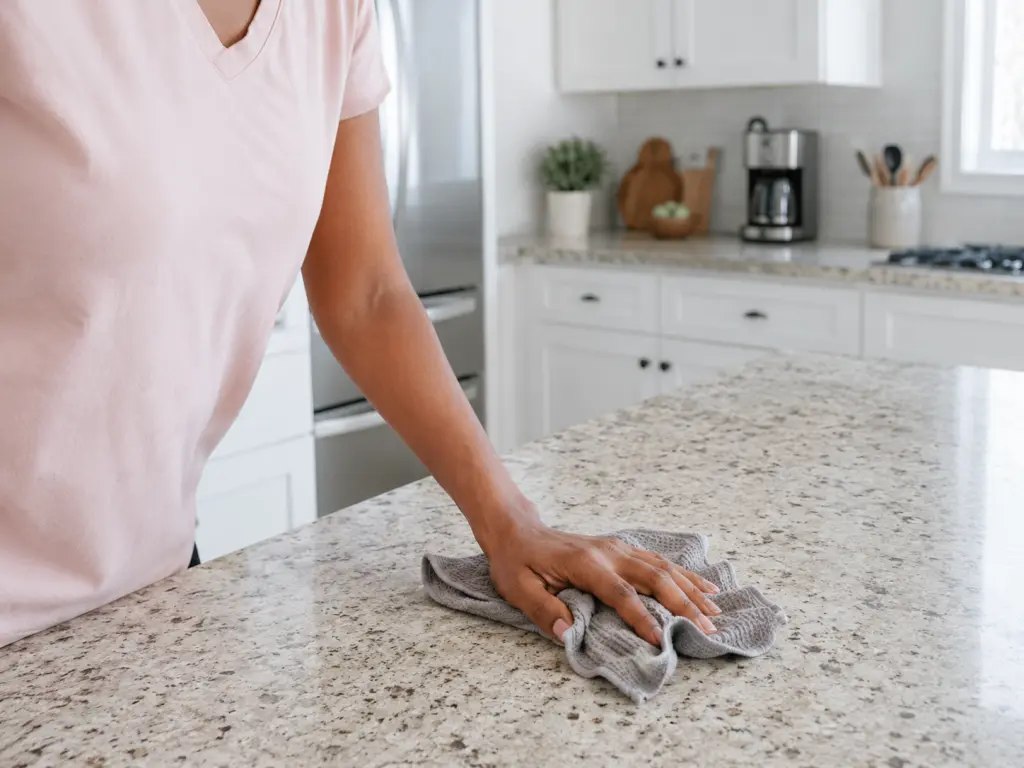
- Wipe the surface with a soft microfiber cloth.
- Use warm water and mild soap or a natural-stone cleaner.
- Remove any remaining residue.
- Dry the countertop when needed.
Avoid abrasive powders and rough pads because they are unnecessary for everyday cleaning.
Around the sink, it is also helpful to wipe standing water and clean product residue instead of allowing it to accumulate.
Can acidic cleaners permanently stain granite?
They can contribute to discoloration, particularly when the granite is more absorbent or the protective sealer has been compromised.
However, not every mark caused by an acidic product is necessarily permanent. The result depends on the type of granite, chemical concentration, exposure time, and condition of the surface.
If you notice a mark, do not immediately reach for a stronger cleaner. Additional chemicals or aggressive scrubbing can make the situation worse.
Instead, stop using the questionable product and determine whether the area needs professional evaluation.
What about hard-water and bathroom cleaners?
Granite bathroom countertops can also come into contact with acidic products designed to remove mineral buildup.
A cleaner that works well on glass, tile, or a shower wall is not automatically appropriate for natural stone.
If you have granite around a bathroom sink, choose a stone-safe cleaner instead of a strong limescale remover.
The same principle applies in the kitchen. Products designed to remove grease or mineral deposits from appliances are not necessarily safe for granite.
Does granite need to be resealed after acidic exposure?
Not automatically.
A single spill does not mean the countertop needs to be resealed.
The need for resealing depends on:
- the granite’s porosity;
- the existing sealer;
- how heavily the surface is used;
- whether liquids are being absorbed more quickly.
A professional can help determine whether the stone actually needs additional protection rather than simply applying sealer on a fixed schedule.
Granite Empire of Nashville can also advise on sealing options when selecting and installing natural stone.
How much do granite countertops cost?
At Granite Empire of Nashville, granite starts at approximately $48 per square foot.
For a basic material estimate:
| Countertop area | Starting granite material |
|---|---|
| 30 sq. ft. | $1,440 |
| 40 sq. ft. | $1,920 |
| 50 sq. ft. | $2,400 |
| 60 sq. ft. | $2,880 |
These are starting material costs, not complete installed prices.
The final project can also include:
- templating;
- fabrication;
- edge finishing;
- sink cutouts;
- cooktop cutouts;
- seams;
- backsplash work;
- delivery;
- installation.
Because Granite Empire of Nashville is a fabricator, the company handles the project from material selection and templating through custom fabrication and installation.
How long does granite countertop installation take?
Most projects take approximately 2-3 weeks overall.
After final templating, fabrication generally takes around 7-10 business days, followed by installation. A standard installation typically takes 1-2 days, depending on the kitchen layout and scope.
The process includes choosing the stone, getting a quote, templating, confirming the slab layout, fabrication, and installation.
For granite countertops in Nashville, TN, this planning is especially useful when the kitchen includes a large island, multiple cutouts, or a detailed backsplash.
How can you protect granite from acidic damage?
The easiest strategy is prevention:
- Use a cleaner made for natural stone.
- Wipe acidic food spills promptly.
- Avoid vinegar and citrus-based countertop cleaners.
- Do not use abrasive powders or rough pads.
- Use cutting boards for food preparation.
- Keep strong chemicals away from the countertop.
- Follow the care recommendations for your specific slab.
- Check whether the stone needs periodic sealing.
These habits are simple enough for everyday use and can help preserve both the granite and its protective finish.
For homeowners considering granite countertops in Nashville, TN, proper care is one of the easiest ways to protect the investment without making the countertop difficult to live with.
Frequently Asked Questions
Can vinegar damage granite?
Repeated use of vinegar-based cleaners can affect the sealer and is not recommended for routine granite care. A cleaner formulated for natural stone is a better choice.
Can lemon juice stain granite?
It can contribute to discoloration, particularly on more absorbent or inadequately sealed granite. Wipe acidic spills promptly.
Can granite etch like marble?
Granite is generally much more resistant to common acids than marble, although certain chemicals can still affect the surface or sealer.
How often should granite be sealed?
There is no universal schedule. It depends on the specific granite, its porosity, the existing sealer, and how heavily the countertop is used.
How much does granite cost?
Granite starts at approximately $48 per square foot at Granite Empire of Nashville. Fabrication and installation are additional.
Does Granite Empire of Nashville install granite countertops?
Yes. The company provides stone selection, templating, custom fabrication, cutouts, edge finishing, delivery, and installation.
Does Granite Empire of Nashville serve Nashville, TN?
Yes. Granite Empire of Nashville serves homeowners looking for granite countertops in Nashville, TN and surrounding areas.
Acidic spills are not a reason to be afraid of granite. The key is to clean them promptly and avoid making acidic or abrasive products part of your regular cleaning routine. With the right care, granite can remain a durable and attractive countertop for many years.