
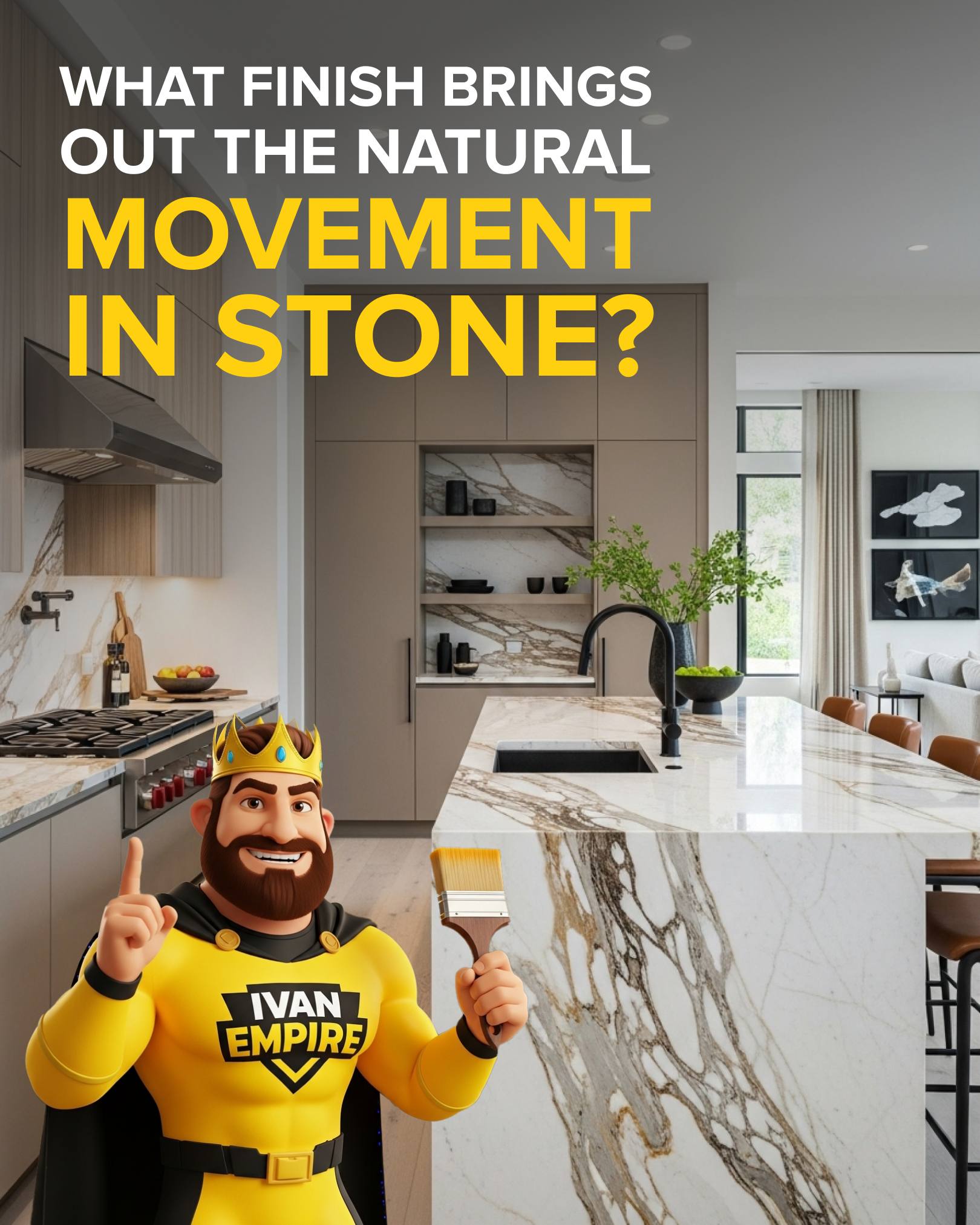
Polished finish brings out the most vivid, high-contrast reading of stone movement — deepening color, sharpening veining definition, and maximizing the visual drama of any pattern. But polished isn’t always the finish that makes stone feel most alive. Leathered finish on the right stone can produce a more tactile, dimensional quality that polished misses entirely. Honed sits between the two — quieter than polished, more readable than leathered, and often the most accurate representation of the stone’s natural character without the amplification that polishing introduces.
The relationship between finish and movement is more nuanced than most homeowners realize when they’re choosing between options in a showroom. Each finish does something genuinely different to the same stone — and understanding what each one actually does is what leads to a selection you’ll still find compelling five years after installation.
At Granite Empire of Nashville, as one of the leading countertop fabricators in Millersville, TN and across Middle Tennessee, finish selection is part of every project conversation we have. Here’s the complete picture.

What does polished finish actually do to stone movement?
Polished finish amplifies. It deepens the stone’s color, sharpens the contrast between background and veining, and makes the pattern read with maximum visual intensity. A polished Calacatta Gold marble looks more dramatic than the same stone honed. A polished Black Pearl granite sparkles in ways that honed Black Pearl doesn’t approach. Polished is the finish that makes stone look the way it does in showroom photography — vivid, reflective, and rich.
The mechanism is straightforward. Polishing creates a micro-smooth surface that reflects light uniformly — like a mirror. On a veined stone, this uniform reflection makes the contrast between light and dark areas appear sharper and more defined. Colors appear deeper because the smooth surface eliminates the light-scattering that a rougher surface produces.
The trade-off is that polished amplifies everything — including the gap between the stone and the actual kitchen environment. A stone that looks extraordinary under focused showroom lighting can look slightly different under the mixed, variable lighting of a real kitchen. Polished surfaces also show fingerprints, water spots, and surface marks most readily of any finish because any disruption to the uniform reflection is immediately visible.
For stones with bold, architectural veining — Calacatta Gold marble, Statuario Venato, Fusion White granite — polished finish is often the most powerful choice. The veining reads with maximum drama and the stone makes its strongest visual statement.
For countertop fabricators in Millersville, TN customers with strongly veined stone selections, polished is worth considering specifically because it maximizes the visual return on a dramatic stone choice.
What does honed finish do to stone movement — and why do some designers prefer it?
Honed finish reveals rather than amplifies. By stopping the polishing sequence before the surface reaches a high-gloss state, honing produces a matte surface that diffuses light rather than reflecting it uniformly. The result is a stone that reads as softer, more natural, and in many ways more like the stone actually looks in geological context — without the mirror-like quality that polishing introduces.
On a heavily veined marble or quartzite, honed finish often produces a reading that feels more authentic. The veining has depth and character without the theatrical sharpness of a polished surface. The background tone reads as truer to the stone’s actual color — polished surfaces often make backgrounds appear slightly darker than they are, while honed shows the stone’s natural tone more accurately.
Honed is also the finish most forgiving in real kitchen conditions. Fingerprints and water spots that are immediately visible on polished surfaces register far less obviously on honed. For homeowners who want to appreciate a stone’s natural movement without the maintenance demands that polished surfaces create in daily use, honed is consistently the more practical path to a finish they’ll still enjoy years later.
The practical limitation of honed on natural stone is porosity. Honed surfaces are slightly more porous than polished because the polishing process closes some surface pores. This means honed granite, marble, and quartzite benefit from slightly more frequent sealing — annually rather than every one to two years. At Granite Empire of Nashville, granite starts at $48 per square foot in 2026 and marble at $68, and sealing guidance is part of every installation conversation regardless of finish.
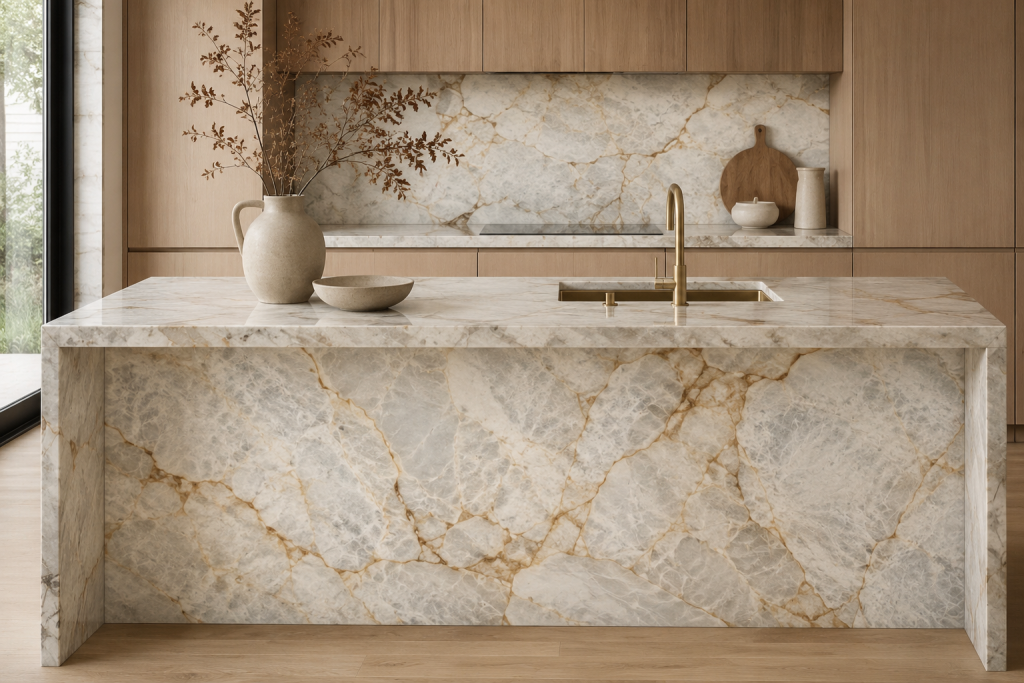
What does leathered finish do — and which stones benefit most from it?
Leathered finish does something entirely different from both polished and honed — it introduces texture to the surface rather than simply adjusting its reflectivity level. Diamond-tipped brushes run across a honed surface raise a subtle undulation that mimics aged leather, giving the stone a three-dimensional tactile quality that polished and honed surfaces don’t have.
On the right stone, leathered finish produces a quality that some designers and homeowners find more compelling than either polished or honed. The texture catches light differently across the day — morning light reveals different aspects of the stone than afternoon light, which creates an experience of the stone that changes rather than staying static. In a kitchen where the countertop is viewed from multiple angles and distances, that dynamism is part of what makes the surface feel genuinely alive.
Leathered works best on stones with strong color or mineral character where the texture amplifies rather than obscures the stone’s natural qualities. Absolute Black granite with a leathered finish is one of the most distinctive countertop surfaces available — the texture reveals a depth in the black stone that neither polished nor honed achieves. Dark quartzite and figured granites similarly benefit from leathering because the texture adds a layer of visual complexity that works with the stone’s existing movement rather than competing with it.
The stones that benefit least from leathering are very fine-grained or very light varieties where the texture reads as roughness rather than depth. A bright white marble with very delicate veining loses more than it gains from a leathered finish — the texture slightly obscures the veining definition that makes those stones beautiful.
| Finish | What It Does to Movement | Best Stone Types | Main Trade-Off |
|---|---|---|---|
| Polished | Amplifies — maximum contrast and drama | Strongly veined marble, quartzite, figured granite | Shows fingerprints most visibly |
| Honed | Reveals — natural, authentic reading | Versatile across all stone types | Slightly more porous, needs sealing |
| Leathered | Transforms — adds tactile dimension | Dark granite, strongly colored stone | Can obscure fine veining detail |
How does the same stone read differently across all three finishes?
The most useful way to understand finish effects is to imagine the same stone in all three finishes — which is exactly what we encourage homeowners to do before committing.
Take a mid-range Calacatta Vagli marble. Polished, it looks sharp, vivid, and high-contrast — the white background appears bright and the gray-gold veining reads with maximum definition. This is the finish that makes Calacatta Vagli look the way it does in design publications. Honed, the same stone reads as softer and warmer — the background shifts slightly toward cream, the veining becomes less sharp but gains a more organic quality. Leathered would add texture but in a stone with this much fine veining, it risks reducing the clarity of what makes the variety visually compelling.
Now take Absolute Black granite. Polished, it looks sleek and mirror-like — strong and contemporary. Honed, it loses some depth and reads more as a flat dark surface. Leathered reveals something that neither polished nor honed achieves — a dimensional quality in the black stone that gives it warmth and visual interest that polished doesn’t deliver and honed doesn’t approach.
This stone-specific variation is why finish selection shouldn’t be made in the abstract. Quartz from brands like Cambria, Silestone, and Caesarstone offers multiple finish options — polished, honed, and satin variants — and their consistency across a production run means the finish selection decision is particularly consequential and predictable. Quartz starts at $58 per square foot at Granite Empire of Nashville in 2026.
For anyone finalizing plans with countertop fabricators in Millersville, TN, Granite Empire of Nashville serves Millersville and Sumner County from our Nashville showroom. Our team works through finish samples alongside specific stone selections before any fabrication decision is made — because finish is one of the few countertop decisions that’s very difficult to change after the stone is installed. Most projects are completed within two to three weeks from template to installed countertops. Reach us at (615) 200-1591 or visit us at 4160 Gallatin Pike, Nashville, TN 37216.