

Matte finishes — honed and leathered — do not show more wear than polished in high-use areas. In most real kitchens, they show less. The assumption that polished is more durable comes from confusing surface appearance with structural performance, and it leads many homeowners to choose a finish that actually requires more daily maintenance than the alternative they dismissed.
The stone’s hardness determines wear resistance. The finish determines how that wear appears. Those are two separate things, and understanding the difference is what leads to a finish choice you’ll still be happy with five years from now.
At Granite Empire of Nashville, one of the leading granite stores in Fairview, TN and across Middle Tennessee, finish questions come up in nearly every project conversation. Here’s the honest picture.
Does finish affect how durable the stone actually is?
No — finish is a surface treatment, not a structural property. A honed granite and a polished granite cut from the same slab have identical hardness, identical scratch resistance, and identical heat tolerance. The Mohs rating doesn’t change based on how the surface was finished.
What finish does affect is how the surface reads visually under daily use conditions — fingerprints, water spots, micro-abrasion, and minor surface contact. And here the two finishes behave very differently in ways that matter significantly for a high-use kitchen.
A polished surface reflects light sharply and uniformly. Any disruption to that uniform reflection — a fingerprint, a water spot, a faint scratch — is immediately visible because it breaks the mirror-like consistency. The stone itself is no worse. But the disruption is obvious.
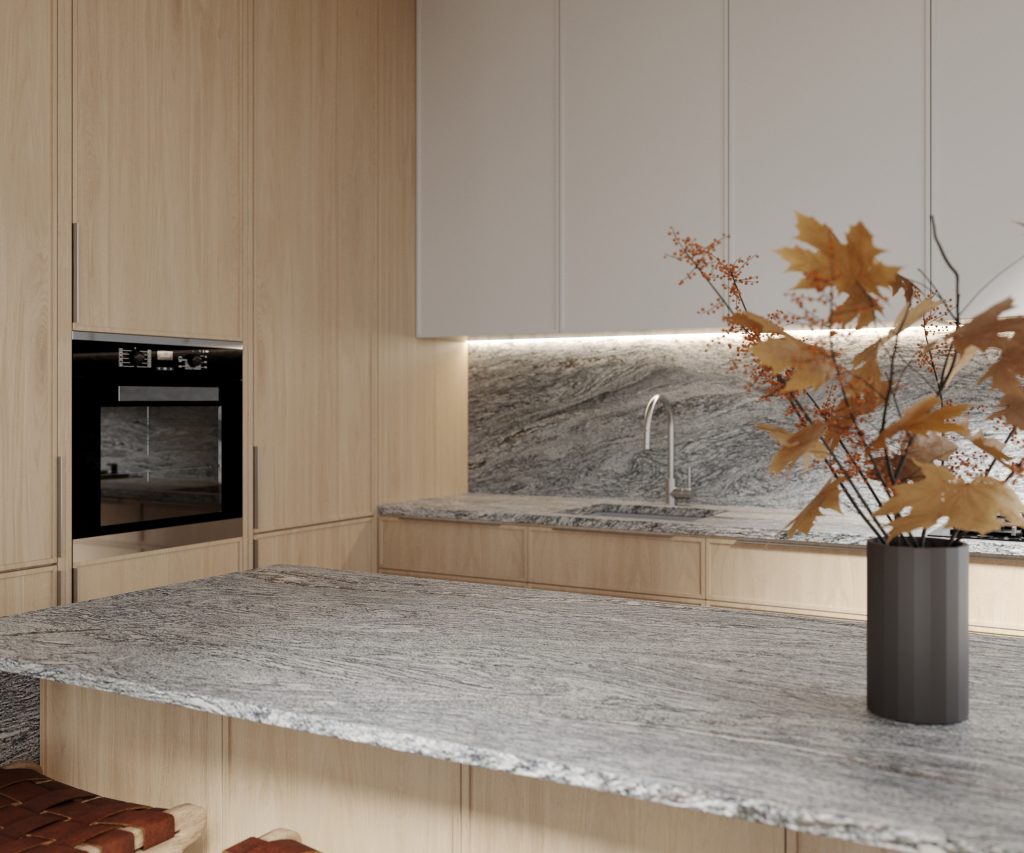
A matte surface diffuses light rather than reflecting it. The same fingerprint, water spot, or minor surface contact is far less visible because there’s no uniform reflection to disrupt. The stone reads as consistently clean even when it technically isn’t — which in a working kitchen is a meaningful practical advantage.
For anyone visiting granite stores in Fairview, TN, this granite finish conversation is one of the most practical decisions to work through before slab selection — because the same stone in a different finish can behave completely differently in a busy kitchen over time.

How do polished and matte finishes compare across materials in high-use areas?
The finish-versus-material interaction is different for each stone — and choosing the right combination is more nuanced than simply picking a finish category.
Granite performs strongly in both polished and matte finishes in high-use areas. Polished granite shows fingerprints and water spots readily — particularly on darker varieties like Absolute Black or Black Pearl where the contrast between the high-gloss surface and any mark is stark. Honed granite on those same dark varieties is dramatically more forgiving day-to-day. For lighter granites like Kashmir White or Bianco Romano, the difference is less pronounced. Leathered granite — particularly on dark stones — is the most maintenance-friendly finish in high-use areas because the texture conceals contact marks almost entirely. Granite starts at $48 per square foot at Granite Empire of Nashville in 2026.
Quartz in polished finish shows fingerprints and smudges more readily than any other material in this group — the engineered surface produces a very consistent high gloss that makes every mark visible. Matte and satin quartz finishes from brands like Cambria, Silestone, and Caesarstone address this directly and have become increasingly popular for exactly this reason. A matte quartz surface in a high-use kitchen reads as consistently cleaner with significantly less wiping than polished quartz. Quartz starts at $58 per square foot at Granite Empire of Nashville in 2026.
Marble presents the most nuanced finish conversation of any material. Polished marble shows etching — the dull spots caused by acidic contact — with maximum visibility because the etch mark disrupts the high-gloss surface sharply. Honed marble shows the same etching at a fraction of the visual impact because there’s no gloss to contrast against. In a high-use kitchen, honed marble is consistently the more livable choice — not because the stone is more durable, but because the finish conceals the inevitable signs of use far more effectively. Marble starts at $68 per square foot at Granite Empire of Nashville in 2026.
Quartzite in either finish performs well in high-use areas — its hardness at Mohs 7 and above means actual surface wear is minimal regardless of finish choice. The finish decision for quartzite is primarily aesthetic and maintenance-driven rather than durability-driven. In the Nashville, TN area, quartzite typically starts around $75 to $95 per square foot installed in 2026.
| Material | Polished in High-Use | Matte in High-Use | Finish Recommendation |
|---|---|---|---|
| Granite | Shows fingerprints readily | More forgiving daily | Honed or leathered for busy kitchens |
| Quartz | Shows smudges most visibly | Significantly cleaner-looking | Matte for high-traffic areas |
| Marble | Etching highly visible | Etching nearly invisible | Honed strongly recommended |
| Quartzite | Good — minor marks visible | Very good | Either works — aesthetic choice |
What about leathered finish specifically — does texture trap debris?
Leathered finish introduces a subtle texture to the stone surface — gentle undulation produced by diamond-tipped brushes run across a honed surface. It’s not rough, but it’s not flat. That texture raises a practical question: does it trap debris and become harder to clean in high-use areas?
In practice, no — not in any meaningful way. The texture of a leathered stone finish is subtle enough that normal wiping with a damp cloth cleans it effectively. Food residue and crumbs don’t lodge in the texture the way they might in a grouted tile surface. Day-to-day cleaning requires no more effort than a polished or honed surface.
Where leathered finish performs best is in the specific high-use areas where polished finishes struggle most — around the sink, the primary prep zone, and near the stove. These are the locations where water spots, oil residue, and cooking debris accumulate daily. The leathered texture conceals all of these better than any flat finish, which is why leathered granite and quartzite in dark tones are among the lowest-maintenance countertop surfaces available for active kitchens.
Does matte finish require different cleaning or sealing?
Cleaning requirements are the same across all three finishes — mild dish soap, warm water, non-abrasive cloth. No finish requires a specialized cleaning product for daily maintenance, and no finish is compatible with bleach, acidic cleaners, or abrasive pads regardless of stone type.
Sealing requirements have a minor difference worth knowing. On natural stones — granite, marble, quartzite — honed surfaces are slightly more porous than polished because the polishing process closes some surface pores. This means honed stone may benefit from slightly more frequent sealing than polished — annually rather than every one to two years for granite, for example. The difference is marginal and easily managed, but worth factoring into the maintenance expectation.
Leathered finish sits between polished and honed on the porosity spectrum — the texturing process opens the surface slightly less than honing alone. Sealing requirements are similar to honed.
Quartz requires no sealing in any finish — polished, matte, or satin. The non-porous engineered structure means finish choice has no sealing implications whatsoever.
At Granite Empire of Nashville, we serve Fairview and the broader Williamson County area from our Nashville showroom. Whether you’re deciding between a polished and honed finish on granite, evaluating matte quartz brands, or choosing between marble finishes for a kitchen that sees daily heavy use, our team walks through finish samples as part of every project conversation. Reach us at (615) 200-1591 or visit us at 4160 Gallatin Pike, Nashville, TN 37216.
Frequently Asked Questions
Do matte stone finishes show more wear than polished in a kitchen?
No — in most high-use kitchens, matte finishes show less visible wear than polished. Polished surfaces reflect light uniformly, which makes fingerprints, water spots, and minor marks immediately visible. Matte and leathered surfaces diffuse light and conceal the same marks far more effectively. The stone’s actual durability is identical regardless of finish.
How much do countertops cost at granite stores in Fairview, TN in 2026?
At Granite Empire of Nashville, granite starts at $48 per square foot, quartz at $58, and marble at $68 in 2026. In the Nashville area, installed countertop costs typically range from $50 to $150 per square foot depending on material and complexity. For a standard kitchen of 40 to 50 square feet, most projects fall between $2,500 and $6,500 fully installed.
Is honed marble a better choice than polished for a busy kitchen?
Yes — significantly. Honed marble shows etching at a fraction of the visual impact of polished marble, because there’s no high-gloss surface for the dull etch mark to contrast against. For any marble installation in an active kitchen, honed is the finish we recommend consistently at Granite Empire of Nashville.
How long does countertop installation take?
Most projects at Granite Empire of Nashville are completed within two to three weeks from first contact to installed countertops. Fabrication runs five to seven business days after the template appointment, and installation is completed in one to two days for most standard kitchens.
Does Granite Empire of Nashville serve Fairview, TN?
Yes. We are one of the leading granite stores in Fairview, TN area, serving Fairview and Williamson County from our Nashville showroom at 4160 Gallatin Pike, Nashville, TN 37216. We have no separate office in Fairview, but we work with homeowners there regularly. Call us at (615) 200-1591 to schedule a visit or discuss your project.