
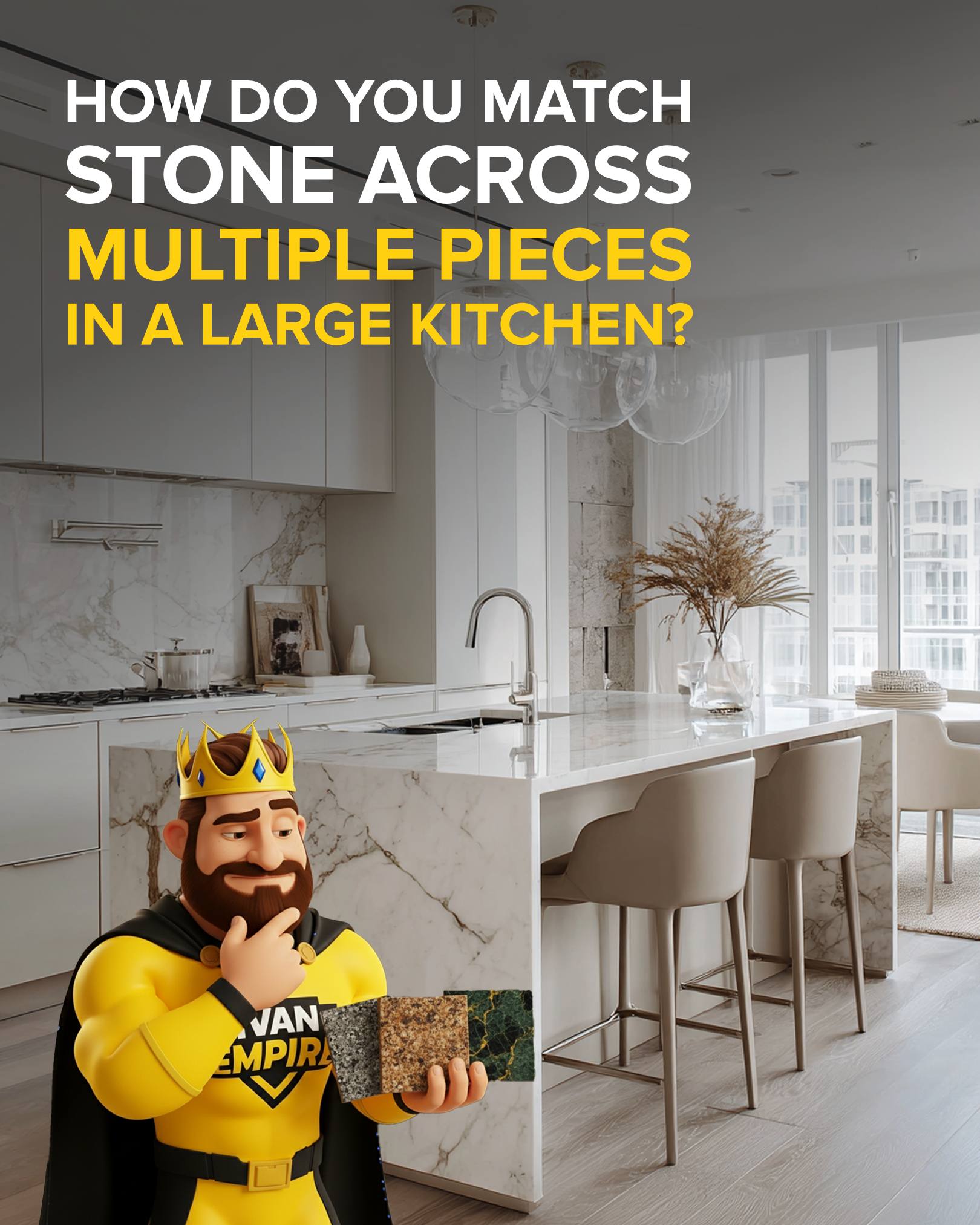
Large kitchens are one of the most rewarding renovation projects — and one of the most technically demanding when it comes to stone selection. The challenge isn’t finding a material you love. The challenge is making sure that material looks intentional, cohesive, and visually consistent once it’s spread across an island, a perimeter counter, a backsplash return, and possibly a secondary prep area. That’s a very different problem from choosing a single slab for a small galley kitchen, and it requires a different approach entirely.
The most common mistake we see at Granite Empire of Nashville is homeowners who select a stone they love in the showroom, approve a sample or a single slab photo, and then discover during installation that the pieces don’t read as a unified surface. Not because anything went wrong technically — but because natural stone is never perfectly consistent, and nobody walked them through what that actually means at scale.
For anyone planning a larger kitchen renovation and researching kitchen countertops in Greenbrier, TN, this is exactly the kind of information that separates a result you’ll love from one that leaves you quietly wondering what went wrong.
Why Natural Stone Is Never the Same Twice — Even From the Same Block
Every slab of granite, marble, or quartzite is cut from a natural stone block that formed over millions of years under specific geological conditions. Even consecutive slabs cut from the same block — what fabricators call “book-matched” pairs — will show variation in background tone, vein intensity, and mineral distribution. Move further apart in the quarry sequence and the differences become more pronounced.
This is not a flaw. It’s the defining characteristic of natural stone, and it’s part of what makes it beautiful. But in a large kitchen where four, five, or six separate stone pieces need to coexist visually, that variation requires active management. Left unmanaged, the result can look like mismatched pieces assembled from different materials rather than one cohesive design.
Granite with strong movement is particularly sensitive to this. Two slabs of the same variety can have dramatically different visual weights — one busy and dramatic, one quieter and more mineral. Placed side by side in an L-shaped kitchen, they can create a visual tension that no amount of lighting or styling will fully resolve. Marble with bold veining presents similar challenges, especially when a prominent vein in one piece has no counterpart in the adjacent section.

The Book-Matching Technique: When It Works and When It Doesn’t
Book-matching is the most precise method of achieving visual continuity across multiple stone pieces. It involves cutting two consecutive slabs from the same block and orienting them as mirror images — the way you’d open a book — so that the veining flows symmetrically across both surfaces. When it works, the result is one of the most striking visual effects available in stone fabrication.
The limitation is that book-matching requires very specific conditions. The slabs must be consecutive cuts from the same block. The kitchen layout must allow for symmetrical placement. And the stone variety must have directional veining that actually reads as intentional when mirrored — not all stones do. Heavily figured marbles like Calacatta Gold or Statuario are natural candidates. More randomly structured granites often are not.
At Granite Empire of Nashville, when clients come to us with large kitchen projects, we look at the layout first before recommending a matching strategy. Book-matching is a powerful tool, but it’s not always the right one. Sometimes a different approach — what fabricators call “flow matching” — delivers better results with less constraint on layout.
Flow Matching: The More Flexible Alternative
Flow matching doesn’t require mirror-image symmetry. Instead, it involves selecting slabs with similar overall movement, tone, and energy — then orienting the cuts so that the visual direction of the stone flows continuously from one piece to the next, even if it isn’t perfectly symmetrical.
This is the approach that works best for most large American kitchens, which tend to have irregular layouts with islands, peninsulas, and varying counter depths that don’t lend themselves to strict book-matching. Done well, flow matching creates a kitchen where the eye travels naturally across the surface without stopping at seams or noticing inconsistency. Done poorly — or not done at all — it produces the mismatched look that homeowners remember for years.
The key is slab selection. Flow matching requires viewing full slabs together in person, not approving individual pieces from separate visits or online photos. The relationship between pieces is what matters, and that relationship is only visible when the slabs are physically compared side by side.
For homeowners planning larger projects and looking at kitchen countertops in Greenbrier, TN, this is one of the most practical reasons to visit a showroom with your full layout dimensions in hand rather than browsing samples remotely.
How Seam Placement Affects Visual Continuity
Even perfectly matched slabs can look disconnected if seams are placed without regard for the stone’s movement. A seam that cuts across a strong diagonal vein mid-island will draw the eye immediately — not because the seam itself is visible, but because the visual logic of the stone is interrupted. A seam placed where the stone naturally calms, where a vein completes its arc, or where the pattern has a natural pause, becomes almost invisible.
Seam placement is part of the fabrication planning process, and it should happen before cutting begins — not as an afterthought. We always review seam placement with clients on large kitchen projects because the homeowner’s perspective on what they want to emphasize, and what they want to minimize, matters. The island front edge that faces the living room is not the same visual priority as the back wall counter that’s rarely seen straight-on. Those differences should drive seam decisions.
Standard kitchen layouts typically require one to three seams depending on counter length and configuration. Islands over eight feet long almost always require at least one seam. Managing that seam well is a fabrication skill — but choosing where it lands is a design decision that benefits from the homeowner’s input.

Mixing Materials in a Large Kitchen: Rules That Actually Work
Not every large kitchen uses a single stone throughout. Islands in a different material from the perimeter counter have been a strong design trend for several years, and when executed well, the contrast adds depth and intention to the space. When executed poorly, it looks like two unfinished renovation phases that never came together.
The materials that mix most successfully share at least one tonal anchor. A white marble island paired with a warm white quartz perimeter works because the background tones are close enough to read as a family. A dark quartzite island against a light gray quartz perimeter works because the contrast is deliberate and consistent. What tends to fail is mixing materials with competing undertones — a cool blue-gray granite against a warm beige quartz, for example — where neither material anchors the other and the kitchen reads as visually restless.
Hardware and cabinet color do a significant amount of work in resolving or amplifying these contrasts. Warm brass hardware can bridge a cool stone and a warm cabinet. Matte black hardware can unify a high-contrast material combination by giving the eye something consistent to return to. These are not afterthoughts — they’re part of the same design decision.
At Granite Empire of Nashville, we work with clients on material combinations regularly, and we serve the Greenbrier area and surrounding communities across Middle Tennessee from our Nashville locations. If you’re planning a kitchen where stone matching across multiple surfaces is part of the brief, our team can walk you through slab selection, seam planning, and material pairing before any cutting begins. Reach us at (615) 200-1591 or visit us at 4160 Gallatin Pike, Nashville, TN 37216.
For anyone finalizing plans for kitchen countertops in Greenbrier, TN, seeing full slabs together in person — rather than approving pieces individually — is the single most valuable step you can take before committing to fabrication.
Frequently Asked Questions
What is book-matching in stone countertops? Book-matching involves using two consecutive slabs cut from the same stone block, oriented as mirror images so the veining flows symmetrically across both surfaces. It’s most effective with strongly veined marbles and requires a layout that accommodates symmetrical placement.
How many slabs does a large kitchen typically require? Most large kitchens with an island and full perimeter counters require two to four slabs depending on square footage and layout. Islands over eight feet long often require more than one slab on their own.
Can you mix granite and quartz in the same kitchen? Yes. Mixing materials works well when the pieces share a tonal anchor — similar background tone or a consistent undertone. The combination that tends to fail is two materials with competing undertones that neither complement nor contrast with enough intention.
Where should seams be placed on a large kitchen island? Seams should be placed where the stone’s movement has a natural pause — where a vein completes its arc or where the pattern quiets. Cutting across a strong diagonal vein mid-island creates visual interruption that draws attention to the seam rather than away from it.
Does Granite Empire of Nashville serve Greenbrier, TN? Yes. We serve Greenbrier and the broader Robertson County area from our Nashville locations. Customers from Greenbrier are welcome to visit our showroom at 4160 Gallatin Pike, Nashville, TN 37216 to view stones in person.
What is the difference between book-matching and flow matching? Book-matching creates mirror-image symmetry using consecutive slabs from the same block. Flow matching selects slabs with similar movement and tone and orients cuts so the stone’s visual direction continues naturally from piece to piece — a more flexible approach that works well for most residential kitchen layouts.
How do I get started with a large kitchen countertop project at Granite Empire of Nashville? Call us at (615) 200-1591 or visit our showroom at 4160 Gallatin Pike, Nashville, TN 37216. For large kitchens especially, we recommend bringing your layout dimensions and cabinet door samples so we can walk you through slab selection and matching strategy from the start.