
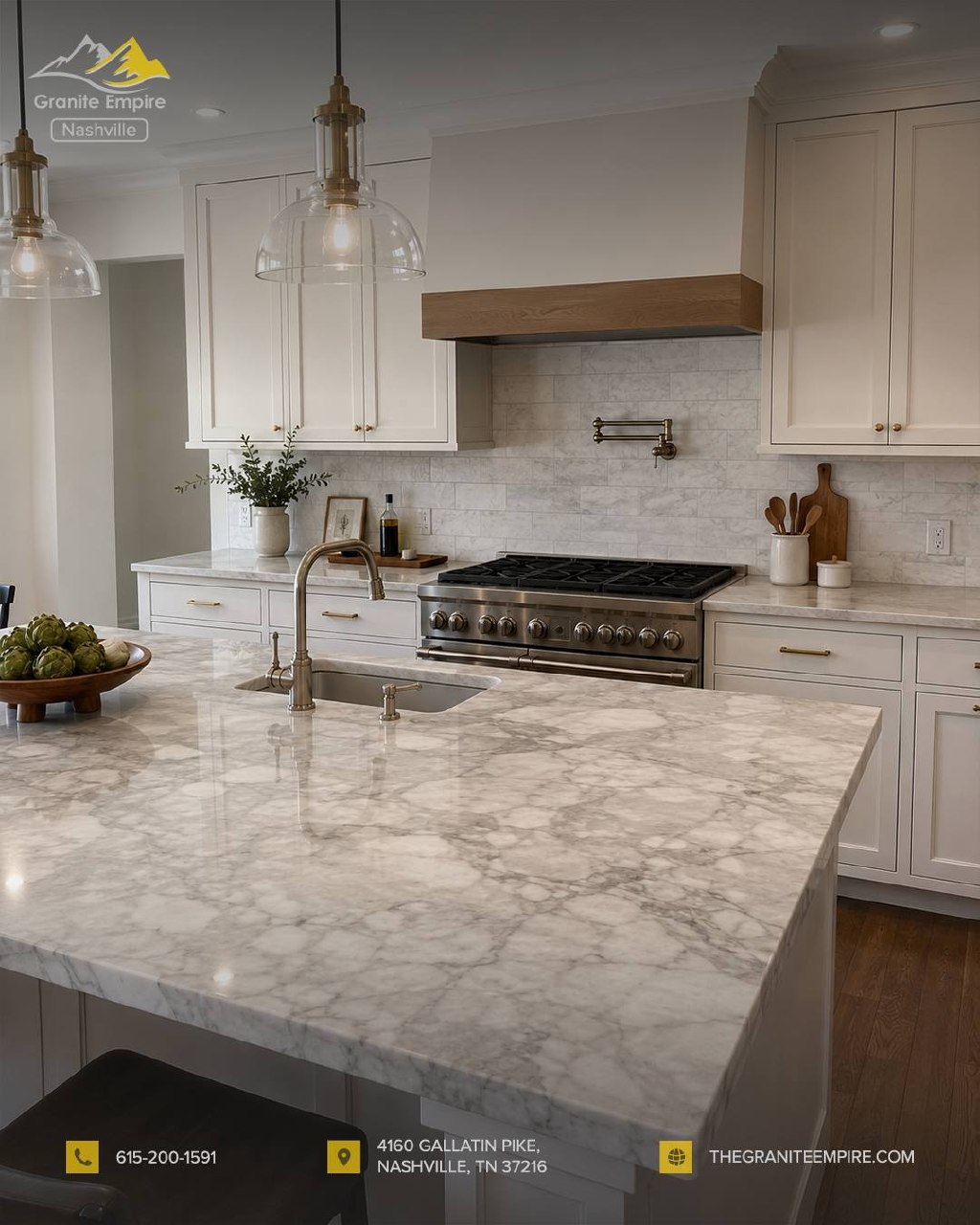
Choosing marble for a kitchen countertop involves more decisions than most homeowners expect when they walk into a showroom drawn by a photograph of Calacatta Gold. The variety, the finish, the veining character, the grade — each of these variables affects both the visual result and the daily experience of living with the material. Getting them right produces a kitchen that looks extraordinary and ages gracefully. Getting them wrong produces one that requires more maintenance than the homeowner bargained for or looks different from what they imagined.
The good news is that the selection process becomes much more manageable once you understand what each variable actually controls — and which ones matter most for your specific kitchen and habits.
At Granite Empire of Nashville, we install marble kitchen countertops in Nolensville, TN and across Middle Tennessee regularly, and guiding homeowners through marble selection is one of the most substantive conversations we have. Here’s the complete guide.

What are the most important marble varieties to know in 2026?
Marble comes from quarries worldwide, but a handful of varieties dominate residential kitchen applications — and understanding what distinguishes them is the starting point for any selection process.
Carrara Bianco is the most accessible and most widely installed marble in American kitchens. Its soft white or light gray background with delicate, fine gray veining has a quiet, classic character that works across a wide range of kitchen styles. It photographs beautifully, works with virtually any cabinet color, and sits at the most accessible price point in the marble category. At Granite Empire of Nashville, marble starts at $68 per square foot in 2026 — Carrara selections sit at the lower end of that range.
Calacatta Vagli and Calacatta Oro step up in visual drama — a brighter white background with bolder gold and gray veining that creates more presence than Carrara without approaching the price premium of the most exclusive Calacatta varieties. These are the most consistently requested mid-range marble selections for kitchen applications and typically run $90 to $120 per square foot installed.
Statuario Venato has the cleanest, most linear vein pattern of the premium white marbles — architectural and sophisticated without the high contrast of Calacatta Gold. It’s the strongest marble choice for modern and transitional kitchens where the design language is precise and restrained.
Calacatta Gold and Calacatta Borghini represent the premium tier — exceptionally bright white backgrounds with bold, dramatic gold veining from limited quarry output. These are the marbles that define the high-end kitchen aesthetic in design publications in 2026. They run $140 to $180 per square foot installed and sometimes higher for select grade slabs.
Arabescato Corchia occupies a practical middle ground — intricate fine-veined gray patterning on a warm white base. Its busier movement conceals daily wear more effectively than calmer varieties, making it one of the most forgiving white marbles for active kitchen use.
For marble kitchen countertops in Nolensville, TN homeowners, this variety landscape is worth understanding before visiting a showroom — not to narrow the decision prematurely, but to have a framework for evaluating what you’re seeing when multiple slabs are in front of you.
How does veining character affect the kitchen result?
Veining is the most visually influential variable in marble selection — and it’s also the variable most commonly evaluated incorrectly from a small sample.
Vein scale — how large and bold the movement is — determines whether the marble reads as dramatic or restrained at kitchen scale. A small sample compresses the movement into a fragment that often misrepresents how the full slab will read once installed across 40 or 50 square feet. A subtle-looking sample can come from a slab with a powerful diagonal vein running across the full piece. A dramatic-looking sample can come from a particularly active section of an otherwise quieter slab.
This is why viewing the full slab — not just a sample — is non-negotiable for marble specifically. The slab tells a different story than the sample in ways that affect the final installation significantly.
Vein direction matters for the kitchen layout. Horizontally-oriented veining in a counter run makes the surface feel longer. Diagonal veining creates dynamic energy that draws the eye. Soft cloudlike movement distributes the pattern evenly without strong directionality. The fabricator’s cut layout — how the slab is oriented and where the cuts are placed — should align veining direction with the kitchen’s geometry.
Vein contrast between the background and the veining itself affects how active the stone reads. High contrast — bold dark gray veins on bright white — makes a statement from across the room. Low contrast — soft gray veins on warm white — reads as quieter and more versatile across cabinet colors and hardware choices.
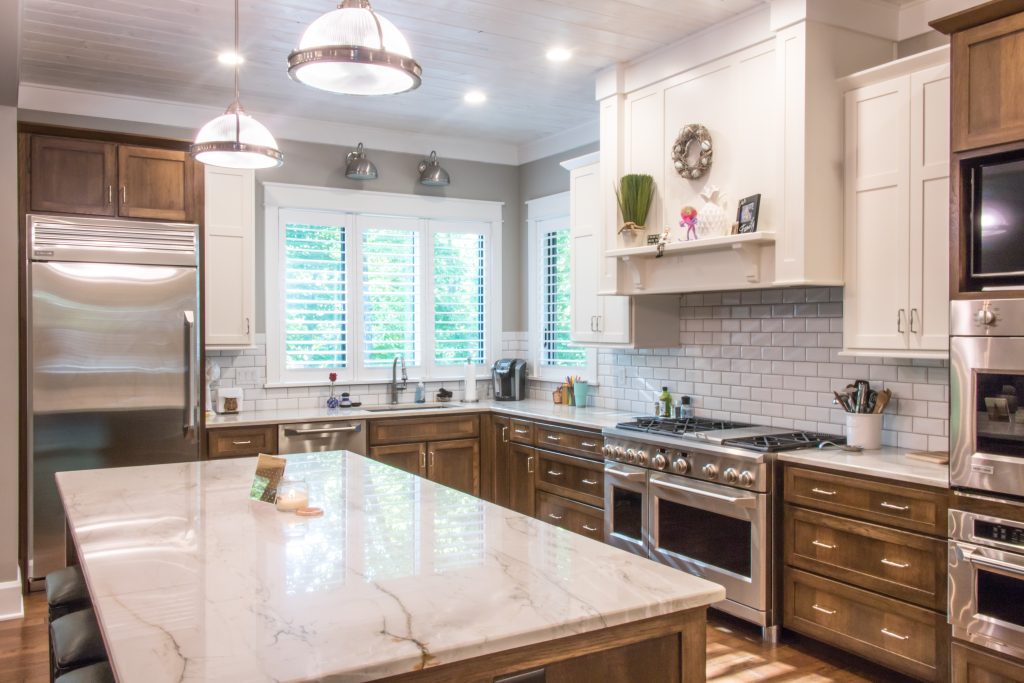
How much does finish choice affect the marble selection decision?
Significantly — and finish is the decision most often made as an afterthought that should be made as part of the material selection.
Polished marble has a high-gloss surface that maximizes the stone’s visual depth and luminosity — the quality that makes marble most unmistakably marble. It reflects light sharply, deepens color, and makes veining appear most vivid. The trade-off in a kitchen is that etching — the dull spots created by acidic contact — contrasts sharply against the high-gloss surface and is immediately visible. Polished marble in an active kitchen requires the most consistent attention to acidic food contact of any marble-and-finish combination.
Honed marble has a matte surface that reduces the visual depth slightly but reduces etching visibility dramatically. The dull spot that etching creates on polished marble is nearly invisible on a honed surface because there’s no high gloss to contrast against. For most active kitchens, honed is the finish recommendation we make consistently at Granite Empire of Nashville — not because it’s more beautiful, but because it’s more livable for the majority of cooking habits.
The variety and finish combination matters. A honed Calacatta Gold still reads as exceptional. A polished Arabescato Corchia with its busier movement conceals etching better than polished Calacatta. Matching the finish to the variety and the kitchen’s use intensity is what produces the best long-term result.
What grade of marble should homeowners choose?
Marble grading reflects consistency of veining, background color uniformity, and structural soundness — and the right grade depends on the project’s budget and visual priorities.
Commercial grade marble has more variation in background color and veining consistency, possible filled fissures, and price that reflects the lower uniformity. For homeowners who appreciate the natural variation and aren’t seeking a perfectly consistent slab, commercial grade can deliver excellent visual character at a more accessible price. Commercial grade material typically runs $40 to $60 per square foot before fabrication.
Standard grade delivers consistent color and veining quality that meets most residential expectations. This is where the majority of kitchen marble projects land — predictable enough to plan around, characterful enough to be beautiful. Standard grade material runs $50 to $90 per square foot.
Premium or select grade represents near-perfect slabs with appealing dramatic veining, flawless surfaces, and the most consistent background color. This is the grade associated with the most photographed marble kitchens — the Calacatta Gold islands that appear in design publications. Premium grade material runs $80 to $150 per square foot or more for the rarest varieties.
The grade decision should be made at the slab — not from a price tier chart. Two standard grade Calacatta Vagli slabs from the same quarry batch can look meaningfully different in ways that are only apparent when the slabs are physically compared.

How should the selection process actually work from start to finish?
The process that consistently produces the best marble selection outcomes follows a specific sequence — and the sequence matters because each step informs the next.
Start with the kitchen’s design direction — cabinet color, hardware finish, flooring tone, and whether the aesthetic is modern, transitional, or traditional. This narrows the marble category before any slab viewing begins. Cool white Calacatta for a modern kitchen with white cabinets. Warm Arabescato for a transitional kitchen with wood tones. Quiet Carrara for a traditional kitchen where the stone supports rather than leads.
Then view full slabs — not samples, not website photographs, full slabs — in the varieties that fit the design direction. Step back ten to fifteen feet from each slab and evaluate it from viewing distance. Note the veining scale, direction, and contrast. Bring a cabinet door sample and hold it against the slab.
Confirm the finish before the slab is reserved. For most active kitchens, confirm honed unless there’s a specific reason to choose polished.
Confirm the cut layout with the fabricator before fabrication begins — how the slab sections will be oriented, where seams will land, and how veining will flow across the installed countertop.
For anyone finalizing marble kitchen countertops in Nolensville, TN, Granite Empire of Nashville serves Nolensville and Williamson County from our Nashville showroom. Marble starts at $68 per square foot in 2026 and we carry selections across all variety tiers and grades. Our team walks through every step of this selection process with clients before any commitment is made. Most projects are completed within two to three weeks from template to installation. Reach us at (615) 200-1591 or visit us at 4160 Gallatin Pike, Nashville, TN 37216.