
Yes — and this is one of the most underrecognized causes of stone countertop wear. Unlike a scratch or a crack, cleaning product damage doesn’t happen all at once. It accumulates silently over months and years, through products that seem harmless individually but degrade sealers, resins, and surface finishes with repeated use. By the time the damage becomes visible — a dulled patch, a hazy film, a slightly different texture — most homeowners have no idea what caused it, because the products responsible are sitting in their cleaning cabinet right now.
The good news is that this kind of damage is entirely avoidable, and avoiding it requires almost no extra effort — just choosing the right products from the start rather than reaching for whatever is closest.
At Granite Empire of Nashville, we install countertops in Nolensville, TN and across Middle Tennessee regularly, and questions about cleaning product damage are some of the most common follow-ups we get from homeowners a year or two after installation. Here’s the complete picture.
How does cleaning product damage actually accumulate over time?
The mechanism is different for natural stone versus engineered quartz, but the pattern is the same — small, repeated chemical exposure that individually seems insignificant but compounds with use.
On natural stone — granite, marble, quartzite — the protective layer is the penetrating sealer applied at installation. This sealer fills the stone’s pores and creates a barrier against liquid absorption. Acidic and highly alkaline cleaning products degrade this sealer gradually with each application. The first few uses of an inappropriate cleaner show no visible effect because the sealer absorbs the damage. After months of repeated use, the sealer’s protective capacity diminishes, and the stone becomes more porous — visible as increased water absorption, faster staining, or a duller appearance in high-cleaning areas.
On quartz, the vulnerability is the polymer resin that binds the quartz crystals together. Bleach, highly acidic cleaners, and highly alkaline products attack this resin at a molecular level. Each application causes microscopic degradation that is invisible individually. Over months of regular use — particularly around the sink where cleaning happens most frequently — this accumulates into visible dulling, slight discoloration, or a textural change where the surface feels less smooth than the surrounding area.
In both cases, the damage is cumulative and the timeline is similar — visible effects typically emerge after six months to two years of regular use of an inappropriate product, depending on frequency of use and product strength.
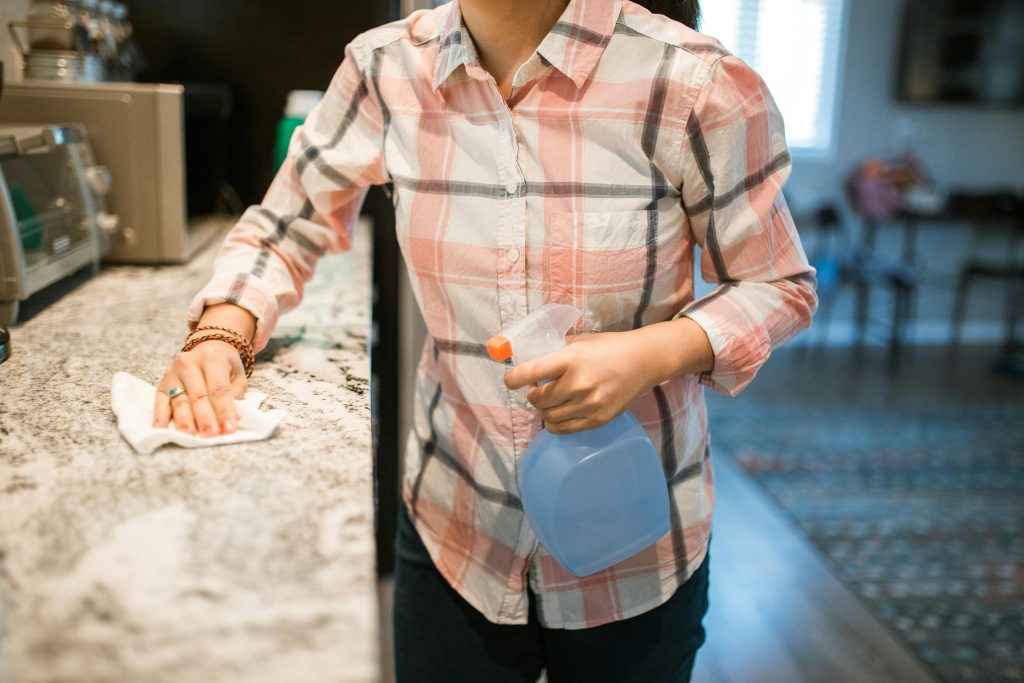
Which common household cleaning products cause this damage?
The products responsible are often ones homeowners use confidently because they’re effective at cleaning — which is exactly the problem. Effectiveness against grease and grime doesn’t mean a product is safe for stone.
Bleach-based sprays — Clorox, generic disinfecting sprays, and bathroom cleaners with bleach as an active ingredient — are the most commonly used damaging products. They’re reached for specifically because they’re perceived as the strongest cleaning option, which means they’re often used more frequently than gentler alternatives. On quartz, bleach is the single most common cause of the gradual resin degradation described above. On natural stone, bleach strips sealer protection with each use.
Vinegar and citrus-based “natural” cleaners are commonly recommended for general household cleaning and are genuinely effective on many surfaces — but they’re acidic, and acidic products are problematic for both natural stone sealers and quartz resins. The “natural” framing leads many homeowners to assume these products are gentler than they actually are for stone surfaces specifically. On marble, vinegar causes immediate etching in addition to the longer-term sealer degradation.
Glass and multi-surface cleaners containing ammonia — Windex and similar products — strip surface finishes gradually with repeated use. These are frequently used on countertops because they’re already in the kitchen for cleaning windows and stainless appliances, and the spray-and-wipe convenience makes them an easy default.
Powdered abrasive cleaners — Comet, Bar Keepers Friend, and similar products — cause physical micro-abrasion rather than chemical degradation, but the cumulative effect is similar: a surface that develops a duller, slightly scratched appearance in areas where these products are used regularly, typically around the sink.
For homeowners with countertops in Nolensville, TN and similar Middle Tennessee homes, the products causing this damage are very likely already in the cabinet under the sink — which is why awareness matters more than buying anything new.

How does this damage show up differently across granite, quartz, marble, and quartzite?
The visible result of cumulative cleaning product damage varies by material — which is part of why it’s often misattributed to something else entirely.
Granite shows cumulative cleaning damage primarily as increased porosity — areas around the sink where harsh cleaners are used most frequently begin absorbing water and staining more readily than the rest of the countertop. Homeowners often interpret this as “the sealer wore off in that spot” without recognizing that the cleaning products used in that area accelerated the wear specifically. Granite starts at $48 per square foot at Granite Empire of Nashville in 2026.
Quartz shows cumulative damage as a dulling or slight discoloration, often in a vague patch around the sink or in whatever area sees the most frequent disinfecting. Because quartz is marketed as low-maintenance, homeowners are sometimes surprised that it can show wear at all — and the cause is almost always cleaning product choice rather than anything related to daily food prep. Quartz starts at $58 per square foot at Granite Empire of Nashville in 2026.
Marble shows the most visible and immediate damage because acidic cleaning products cause etching on contact, in addition to the longer-term sealer degradation. A marble countertop cleaned regularly with vinegar-based products will show a network of faint dull spots across the cleaned area — distinct from the longer-term porosity changes that affect granite and quartzite. Marble starts at $68 per square foot at Granite Empire of Nashville in 2026.
Quartzite behaves similarly to granite — increased porosity in frequently-cleaned areas — but its higher density means the timeline is typically longer before damage becomes visible. In the Nashville, TN area, quartzite typically starts around $75 to $95 per square foot installed in 2026.
| Material | How Damage Appears | Primary Cause |
|---|---|---|
| Granite | Increased porosity, faster staining | Sealer degradation from harsh cleaners |
| Quartz | Dulling, slight discoloration | Resin degradation from bleach/acid |
| Marble | Network of etch spots | Acidic cleaners — immediate + cumulative |
| Quartzite | Increased porosity (slower onset) | Sealer degradation, denser so slower |
What does safe daily cleaning actually look like — and is it really enough?
Yes — and this is the reassuring part. The products that are safe for stone are also effective for daily kitchen cleaning. Safety and effectiveness aren’t in tension here.
Warm water and mild dish soap handle the overwhelming majority of daily cleaning needs across all four materials — food residue, grease, general surface contact. This combination is pH-neutral, doesn’t degrade sealers or resins, and is effective enough that no “upgrade” to a stronger product is needed for routine use.
pH-neutral stone-specific cleaners — Granite Gold, Black Diamond Stone Care, and similar products — are formulated specifically to be both effective and safe for natural stone and quartz. These are worth keeping for slightly deeper cleaning sessions beyond daily wipe-downs.
Isopropyl alcohol at 70% is safe across all materials and useful for disinfecting needs — after handling raw meat, for example — without the resin or sealer risk that bleach carries.
The practical shift for most households is simply substitution — replacing the bleach spray or Windex bottle that currently lives near the sink with a pH-neutral stone cleaner, and saving the harsher products for surfaces where they’re actually appropriate, like toilets or tile grout.
For anyone finalizing plans for countertops in Nolensville, TN, Granite Empire of Nashville serves Nolensville and Williamson County from our Nashville showroom. We provide cleaning and maintenance guidance for every material we install, specifically so homeowners can avoid the kind of cumulative damage that’s entirely preventable with the right daily habits. Most projects are completed within two to three weeks from template to installed countertops. Fabrication runs five to seven business days after the template appointment, and installation is completed in one to two days for most standard kitchens. Reach us at (615) 200-1591 or visit us at 4160 Gallatin Pike, Nashville, TN 37216.